Client Satisfaction Survey
18 Min Read
Client satisfaction surveys help in understanding client feedback and improving service quality.
Most businesses think they understand their clients. They usually judge this from repeat orders, long-term contracts, or no complaints. These signs often make it feel like everything is fine and clients are happy.
But in real life, silence does not always mean satisfaction. Many times, it is the first sign that something is wrong, even if no one is saying it directly.
Clients do not usually leave all at once. The change is slow. They start expecting less, interact less, and slowly disconnect without explaining the reason.
By the time the business notices this, the relationship has already become weak and harder to fix.
A client satisfaction survey helps prevent this. It turns unclear client experiences into clear feedback that can be understood and used. Its main value is not just collecting answers, but finding problems early before they become serious.
What Is a Client Satisfaction Survey?
A client satisfaction survey is a structured feedback system used to understand how clients perceive their experience with a business.
At a basic level, it collects responses about satisfaction, service quality, and overall experience. But at a deeper level, it works as a perception mapping tool that helps businesses understand how their service is actually experienced by clients, not just how it is delivered internally.
It highlights areas where expectations and reality do not match, where communication may feel unclear, where service delivery may feel inconsistent, and where small friction points slowly build over time.
Most internal teams evaluate performance based on execution. They focus on whether the task was completed, whether the service was delivered, and whether timelines were met.
But clients do not evaluate based on execution alone. They evaluate based on experience.
From their perspective, the questions are different. They focus on whether the process was easy, whether communication was clear, whether updates were timely, and whether the overall experience felt reliable.
This difference between internal execution and client perception is where most satisfaction gaps appear.
The purpose of a client satisfaction survey is to close the loop by understanding how clients view their service experience as opposed to simply looking at how they were provided operationally.
Why perception matters more than internal performance?
A business may believe everything is running smoothly internally because:
All processes are functioning effectively
All teams are working collaboratively toward common goals
All products/services are being delivered effectively
From the client’s perspective:
Communication may appear unclear
Updates may appear minimal
There may be misalignment regarding expectations
So even if delivery is technically correct, the experience can still feel weak.
This is why satisfaction is not an operational metric—it is an emotional interpretation of business interaction.
Why Client Satisfaction Surveys Matter?
Most businesses do not lose clients because of one major failure. In most cases, clients leave because of repeated small issues that build up over time and slowly affect trust in the relationship.
These issues are often not serious on their own, but they still change how reliable a business feels from the client’s point of view.
These micro-frictions include:
Slightly delayed responses
Unclear instructions
Lack of proactive updates
Inconsistent communication tone
Small gaps between expectation and delivery
Individually, these issues may not seem important. But over time, they accumulate and gradually reshape how clients perceive the overall experience and reliability of the business.
The silent churn problem
Silent churn happens when clients stop working with a business without clearly saying why.
This usually happens because clients do not want confrontation, they assume nothing will change even if they share feedback, switching to another provider feels easier, or they feel that feedback will not lead to visible improvement.
So instead of complaining, they slowly disengage.
From the business side, this becomes a hidden problem because silence is often mistaken for satisfaction.
A client satisfaction survey helps uncover this silent drop in engagement before it turns into complete loss of clients.
Why internal assumptions fail
Internal assumptions fail because employees only understand the internal processes of a company while clients will only see the final outcome and not the process used to produce that outcome. Therefore, what is considered 'normal' internally can appear inconsistent or unclear to clients.
For example, if a Team (who has access to information on the reasons for the delay) feels that a delay is acceptable then a client (who has no information on the reason for the delay) will feel that the service received is lacking. This gap between internal context and external perception is one of the major reasons that satisfaction issues are regularly missed.
Business impact
A well-executed client satisfaction survey can provide an organization with the following benefits:
1. Identify early indications of dissatisfaction so that organizations have the opportunity to remedy client dissatisfaction before losing them.
2. Reduce unanticipated or "silent" attrition.
3. Improve the consistency of communication among teams.
4. Assist in aligning the organization’s internal performance expectations with clients’ real experience.
5. Prioritize client improvement initiatives using real feedback instead of assumptions.
In summary, client satisfaction surveys will provide organizations with a more accurate picture of how clients perceive their interactions with their businesses in real life than how the organization believes its performance is.
Types of Client Satisfaction Surveys
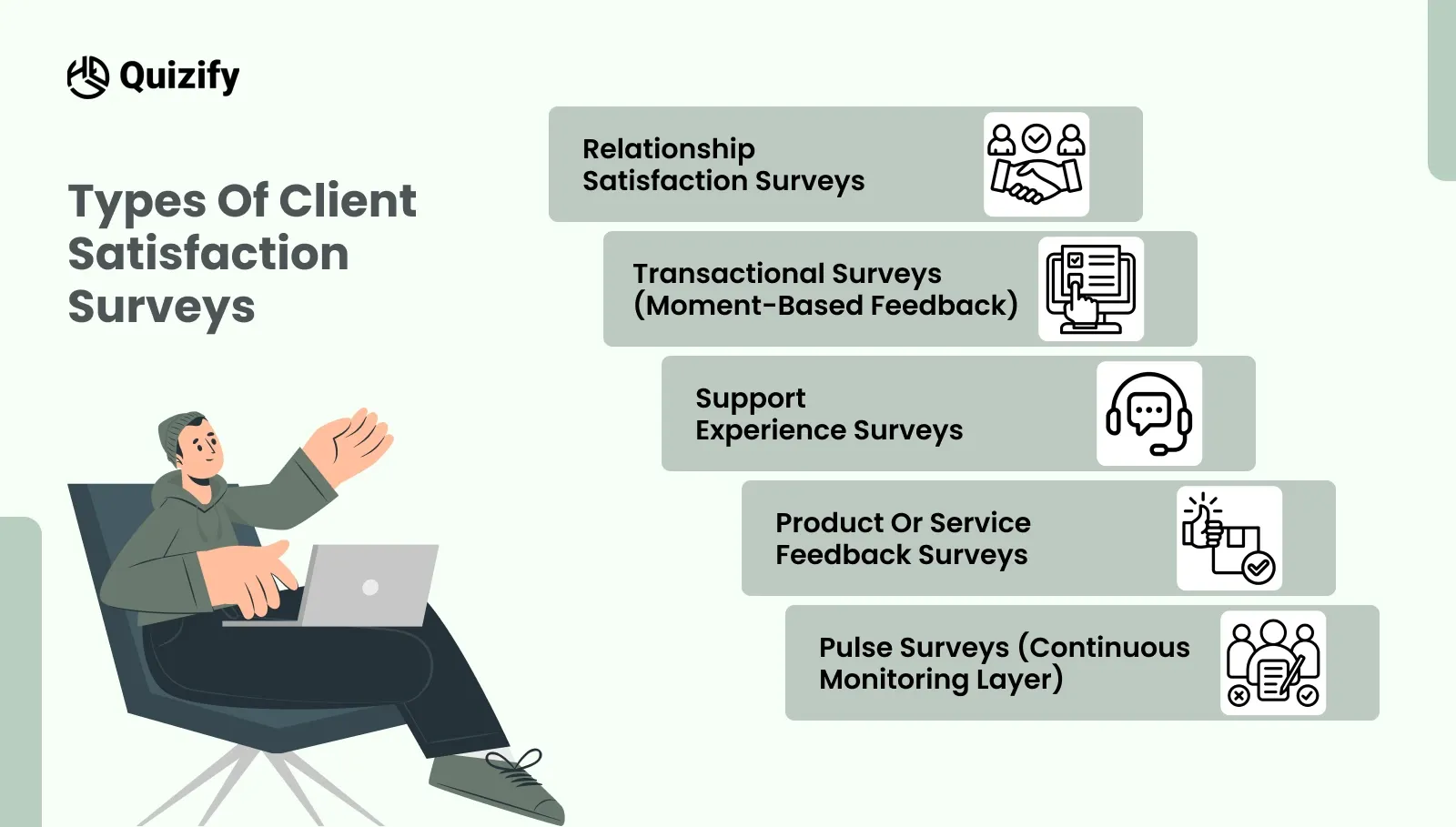
Different surveys exist because client perception changes depending on timing and interaction type. These different survey types can be easily created and managed using Quizify’s Funnel Builder and Create with AI features.
1. Relationship Satisfaction Surveys
Relationship satisfaction surveys look at the client's perception of their business relationship with your company over time. They do not evaluate one specific interaction, but instead evaluate the total experiences the client has had with your company. For example, a relationship satisfaction survey can evaluate how a client's long-term relationship with the company has affected their level of satisfaction, trust, and overall reliability of the brand based on multiple interactions.
The responses in relationship satisfaction surveys reflect the entire journey the client has had with the company, not just one recent experience.
2. Transactional Surveys (Moment-Based Feedback)
Transactional surveys are sent to clients after a specific interaction or outcome with your company. These can be triggered after a service is delivered, a product is purchased, or an issue is resolved.
Transactional surveys collect immediate feedback about how clients felt about that specific experience. Because the feedback is collected right after the interaction, it helps assess how the experience felt to the client and whether they would use that service again.
3. Support Experience Surveys
Interactions during support are very important because they typically occur after a client has experienced difficulty. The survey asks clients how well their issues were resolved, what type of communication they received (how clearly it explained what was happening, how fast the response time was), and how much effort they had to put in to reach a resolution.
Even if they receive the correct solution, clients can still have a negative impression of the interaction due to poor communication.
4. Product or Service Feedback Surveys
Surveys for Getting Information on Products and Services. Surveys that capture information about a product or service include two types: Usability and Functional Experience Surveys. Both give insight into problems in use, including expectations not met or difficulties in using the product or service.
Feedback from these surveys provides information about a service (product) so that changes can be made to improve delivery.
5. Pulse Surveys (Continuous Monitoring Layer)
Pulse surveys are short and frequent check-ins used to track ongoing client sentiment. They help businesses monitor satisfaction changes over time, detect early warning signals, and measure the impact of improvements after changes are made.
Most businesses combine multiple survey types to get a complete understanding of client experience across different stages.
Client Satisfaction Survey Questions
The effectiveness of a client satisfaction survey depends heavily on the quality of questions being asked. Poorly structured questions lead to unclear feedback, while well-structured questions help reveal real client experience in a structured way.
Instead of asking random questions, effective surveys are built in layers. Each layer focuses on a different part of the client experience, from emotional response to service execution and long-term trust.
Service Delivery Layer (Execution Quality)
This layer checks how well the service was delivered. It identifies the gap between what was promised and what was delivered.
Examples include:
Was the service delivered in a consistent manner during every phase of the process?
Did all commitments made during the engagement get met?
Were there any gaps between what was expected and what was delivered?
This layer helps businesses review execution from the client’s perspective.
Communication Layer (Most Critical Driver)
Most Important Driving Force; it affects client satisfaction the most, as even good services can lose trust due to poor or inconsistent communication. Examples of questions include; 1) Was there clear communication throughout the process? 2) Was I kept informed of the status? 3) Was it easy to contact someone on your team? Client perception of service quality is mainly based on communication rather than the service/product itself.
Friction Rating (Measure of How Easy/Difficult)
The Friction Rating rates how easy or difficult the overall process was for users. It looks at the effort taken when interacting with a user; this directly affects overall satisfaction.
Examples include:
Was working with us easy?
Did you experience unnecessary delays or complications?
Were the instructions and processes clear and straightforward?
An outcome can be good, but if the process took too much effort, it will feel bad.
Trust Layer (Long-Term Relationship Indicator)
Trust is one of the most important factors in long-term retention.
This layer assesses clients' confidence in continuing to work with a company.
This could include:
Do you trust our company to deliver on a regular basis?
Would you use our company again if you needed a similar service
A client will decide whether to continue doing business with the company regardless of minor problems.
Recommendation Layer (Advocacy Indicator)
This layer examines the probability of customers referring your company to other people.
In addition, it measures the client's overall satisfaction and confidence in your services.
For example:
How likely are you to recommend us to your friends and family?
What could make you more likely to recommend us?
Recommendation-based feedback indicates how satisfied the customer is overall.
Open Insight Layer (Highest Value Section)
This is the most versatile part of the survey and can provide the most valuable information.
It provides customers with the opportunity to give feedback that may not have been addressed within the structured questions.
For example:
What would you like us to do differently?
What did you like about our service?
Is there anything else you would like for us to know that was not asked in the survey?
The Open Insight Layer may contain responses that provide insights or issues that were missed within the structured questions.
When to Send a Client Satisfaction Survey (Timing Intelligence)
The timing of a client satisfaction survey has a direct effect on the quality of the responses. The timing or the context in which a client receives a well-designed questionnaire can drastically diminish the value of the collected feedback.
Clients respond differently based upon when they complete the survey. If feedback is requested too late in time they will often become vague. Likewise, if requested too soon in time clients may not be able to offer insight on the totality of their experience with your organization.
After service completion
Asking a client to complete a survey immediately upon completion of their service allows you to capture immediate real-time feedback as the experience is fresh in their minds. This enhances their ability to respond accurately and details when asked about their specific interactions, communication was, and the resultant outcome.
After support interaction
Support interactions are driven by problems, which makes the timing of the survey even more important. Having the survey sent after the support issue has been resolved enables the organization to assess how effectively the problem was resolved, how clearly the organization communicated to the client during the period of service, and the client’s overall satisfaction with the end result.
After onboarding
Onboarding is the first time the client has a structured interaction with an organization. Collecting this data during onboarding allows you to identify or verify early friction points in the process, clarify instructions that could cause confusion, and create gaps in service that may have a long-term impact on the overall satisfaction of the client.
After changes or updates
Whenever a business introduces changes, updates, or improvements, client perception can shift.
A survey at this stage helps measure whether the change improved the experience, created confusion, or had no noticeable impact.
Regular cadence surveys
Some surveys are not tied to specific events but are sent periodically. These help track long-term satisfaction trends and identify gradual changes in client sentiment over time.
They are useful for understanding overall direction rather than individual experiences.
Poor timing examples
Not all timing strategies are effective. Some approaches reduce response quality and should be avoided.
Examples include:
Sending surveys randomly without context
Sending too frequently without meaningful changes in experience
Sending surveys when no recent interaction has occurred
Poor timing often results in low engagement and less reliable feedback.
How to Analyse Client Satisfaction Survey Results
Step 1: Segment data
Never rely on averages alone.
Break into:
Client categories
Service types
Time periods
Step 2: Identify repeated patterns
Repeated feedback indicates systemic issues. At this stage, using structured tools becomes important because manual analysis often misses trends hidden inside large datasets.
Analytics report can help organize responses into patterns, making it easier to identify recurring issues without manually sorting data.
Step 3: Compare across time
Look for improvement or decline trends.
Step 4: Prioritize impact areas
Focus on:
Frequent issues
Retention-sensitive feedback
Experience-breaking friction
Step 5: Share insights internally
Feedback must translate into action, not reports.
Best Practices for Client Satisfaction Surveys
Keep surveys short and focused
Ensure clarity in wording
Avoid over-surveying
Maintain consistent timing
Act on feedback visibly
Track trends instead of isolated responses
Common Mistakes Businesses Make
Too many unnecessary questions
Unclear wording
No follow-up action
Ignoring negative feedback
Treating surveys as one-time activity
Failing to communicate outcomes
The biggest failure is not collecting feedback, it is not responding to it.
Turning Feedback Into Action
Feedback only creates value when acted upon.
Examples:
If delays are mentioned:
→ Improve response system
If confusion is mentioned:
→ Simplify communication flow
If inconsistency is mentioned:
→ Standardize delivery process
Small improvements accumulate into significant experience shifts over time.
Real Business Scenario
A service company experiences declining repeat clients without complaints.
They run a client satisfaction survey.
Findings:
Inconsistent communication
Lack of clear updates
Delayed responses
Actions:
Introduced structured communication system
Added update checkpoints
Improved response timelines
Outcome:
Improved retention
Higher satisfaction scores
Better client clarity
Final Thoughts
A client satisfaction survey is not just a feedback tool, it is a continuous intelligence system for business improvement.
It helps organizations:
Understand real client perception
Detect issues early
Improve retention
Align operations with experience
But its effectiveness depends entirely on one thing, action.
Ask clearly.
Listen carefully.
Respond consistently.
When supported by systems like Quizify, it becomes scalable, structured, and operationally meaningful.
Similar Topic
Free Customer Feedback Survey Template
Getting started does not have to be complicated.Quizify includes a ready-to-use customer feedback survey template so you do not have to build one from scratch. It is designed to:



FAQ
Frequently Asked Questions
What is the main purpose of a client satisfaction survey?
The main purpose of a client satisfaction survey is to find out how clients really feel about their experience with a business. This helps businesses identify problems make their service better and build relationships with clients before things go wrong.
How often should businesses send client satisfaction surveys?
It depends on the business. How often they interact with clients. Some businesses send surveys after interactions and others send them every few months to see how clients feel overall.
What makes clients ignore satisfaction surveys?
Clients usually ignore surveys when they are too long or confusing. If surveys are sent often clients might also ignore them.. If clients think their feedback will not make a difference they are less likely to respond.
Should client satisfaction surveys be short or detailed?
Most of the time simple surveys work best. Clients are more likely to finish surveys that're easy to understand and do not take too much time.Longer surveys should only be used when detailed feedback is necessary.
Can negative feedback actually help a business?
Yes it can. Negative feedback is often very valuable because it helps businesses find problems they did not know about make improvements and keep clients from leaving. Businesses that listen to criticism and respond well usually get faster.
What is the difference between customer satisfaction and client satisfaction?
Customer satisfaction generally refers to the level of happiness a person has with a product they have bought. However, client satisfaction encompasses the entire experience including the delivery of the service, continuous communication and the building of trust over time.
How can businesses increase survey response rates?
Businesses can get more survey responses by keeping surveys short and easy, sending them at the right time, using simple language, and showing clients that their feedback leads to real improvements.
Are anonymous client satisfaction surveys
Anonymous client satisfaction surveys can be an excellent way to capture more honest and open feedback since clients will be more relaxed and less hesitant when sharing complaints. Then again, business surveys that identify clients will enable faster problem resolution and the opportunity for direct client follow-up.
What should businesses do after collecting survey feedback?
Once businesses have obtained client feedback, they should analyze the responses to identify problems, prioritize the issues they want to address, communicate discoveries to their staff and notify clients about significant changes whenever possible.
Which metrics are commonly used in client satisfaction surveys?
Some common metrics that businesses use to track client satisfaction include satisfaction ratings, Net Promoter Score, evaluations of the quality of service and communication, among others. These metrics provide businesses with insights into their clients' experiences and perceptions.