Customer Feedback Survey
18 Min Read
A customer feedback survey helps businesses collect real feedback on every interaction and turn insights into better experiences that keep customers coming back.
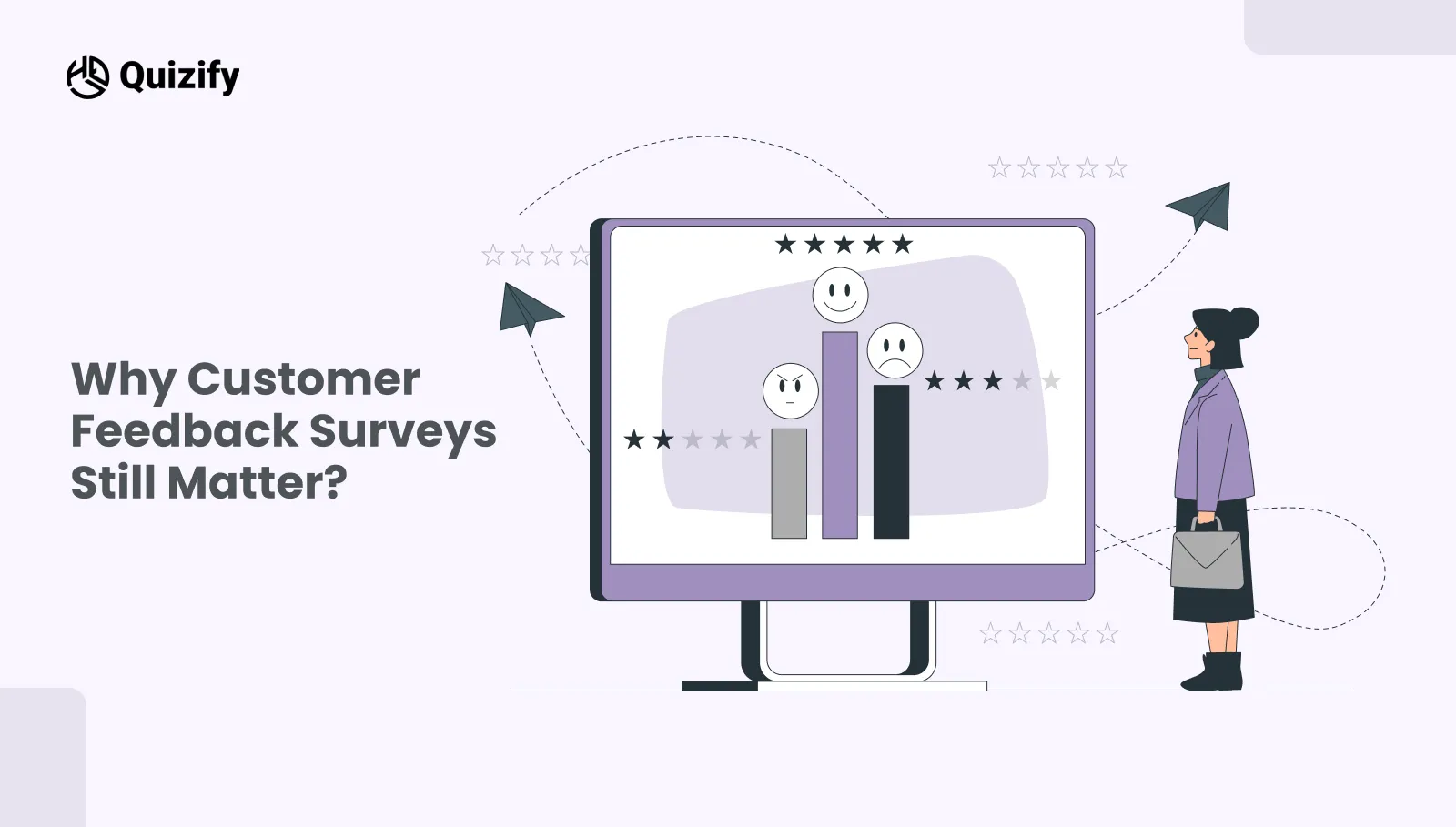
Customer behavior has shifted over the years.
Most dissatisfied customers will not send a long complaint email. They will not call support to explain what went wrong. More often, they simply leave. They cancel. They do not return.
Silence can be expensive.
This is why collecting feedback at the right time matters. A well-placed customer feedback survey allows you to understand what customers are experiencing before disengagement turns into churn. It gives you a chance to correct issues while the relationship still exists.
Used properly, feedback surveys help businesses:
Spot problems before they affect retention
Understand expectations instead of relying on internal assumptions
Improve products using real-world usage feedback
Show customers that their opinions are taken seriously
The value is not in asking as many questions as possible. It is in asking questions that feel timely, relevant, and easy to answer.
What Is a Customer Feedback Survey?
A customer feedback survey is a simple, structured way to collect feedback about the customer experience, satisfaction levels, and what could be better. It helps teams understand how customers see your product or service at specific moments in the journey, like after a purchase, a support chat, or a key action inside the product.
But a good survey is not just a way to “get responses.” It is a chance to listen when the experience is still fresh.
With the right questions, a feedback survey can help you:
Understand how customers feel right after an interaction or purchase
Learn why someone moved forward, or why they decided not to
Spot what felt confusing, frustrating, or surprisingly good
Discover what customers want next from the product or service
The problem is that traditional feedback forms often feel long, generic, or slightly intrusive. People click through them quickly, give short answers, or close the tab.
Interactive surveys work better because they feel more like a conversation. They keep customers engaged, make it easier to give honest input, and usually lead to higher completion rates and better-quality feedback.
Why Traditional Feedback Forms Often Fail
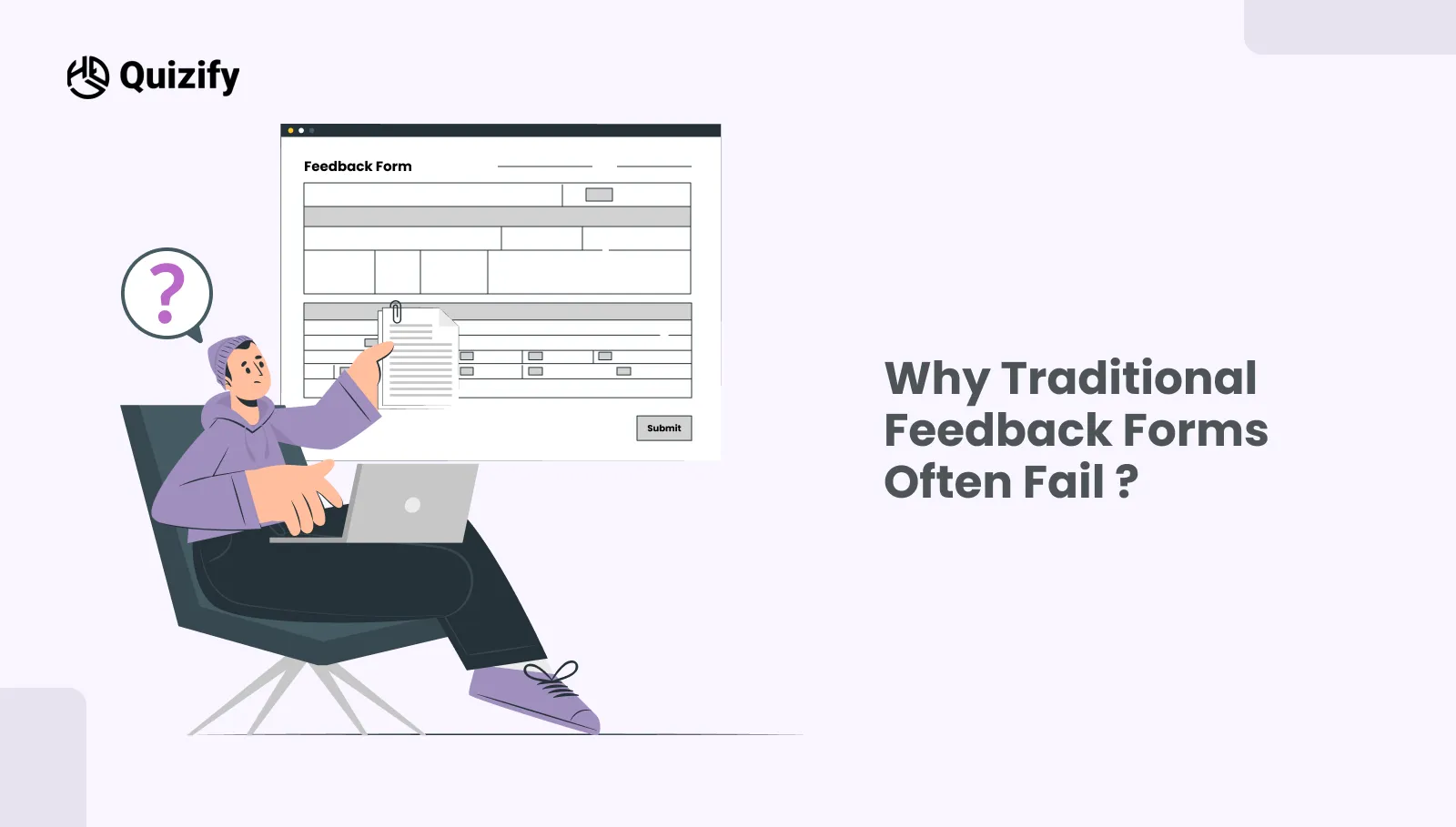
A lot of businesses already “collect feedback,” but still struggle to improve the customer experience. Most of the time, the issue is not missing feedback. It is the way that feedback is collected.
Traditional forms create friction instead of insight. They often:
Ask too many questions in one go
Feel generic and disconnected from what the customer just experienced
Show up at the wrong time, after context is gone
Feel annoying to complete on mobile
Give customers no real reason to bother answering
When a survey feels long or irrelevant, customers either rush through it or ignore it completely. Then you end up with low participation, incomplete responses, and feedback that is too shallow to act on.
A modern customer feedback survey needs to respect the customer’s time while still getting to the truth. If it is focused, well-timed, and easy to complete, the responses are more useful and the insights are easier to act on.
How Quizify Changes the Way You Collect Customer Feedback?
Quizify is built on one simple idea. If a survey feels like a form, people treat it like a form. They rush. They skip. They leave halfway.
If it feels like a short conversation, people answer properly.
That is what Quizify helps you do. Instead of long, static feedback forms, you can create interactive customer feedback surveys that change based on what someone says, so customers only see what actually applies to them.
You do not need to be technical or “good at design” to build one. You pick a template or start fresh, write your questions, and publish it.
The experience on the customer side is also different. Questions show up one at a time, so it never feels like a big list to get through. People stay with it longer, and completion rates tend to be higher because the survey feels lighter.
Conditional logic is built in, so you can go deeper when it matters without making the survey longer for everyone. If someone had a bad experience, you can ask what went wrong. If they are happy, you can skip the troubleshooting and move on.
And because most customers respond on their phone, every Quizify survey is mobile-friendly by default. No extra layout work. No broken screens.
As responses come in, you can see them right away. That makes it easier to spot repeating complaints, identify what is working, and act while the experience is still fresh.
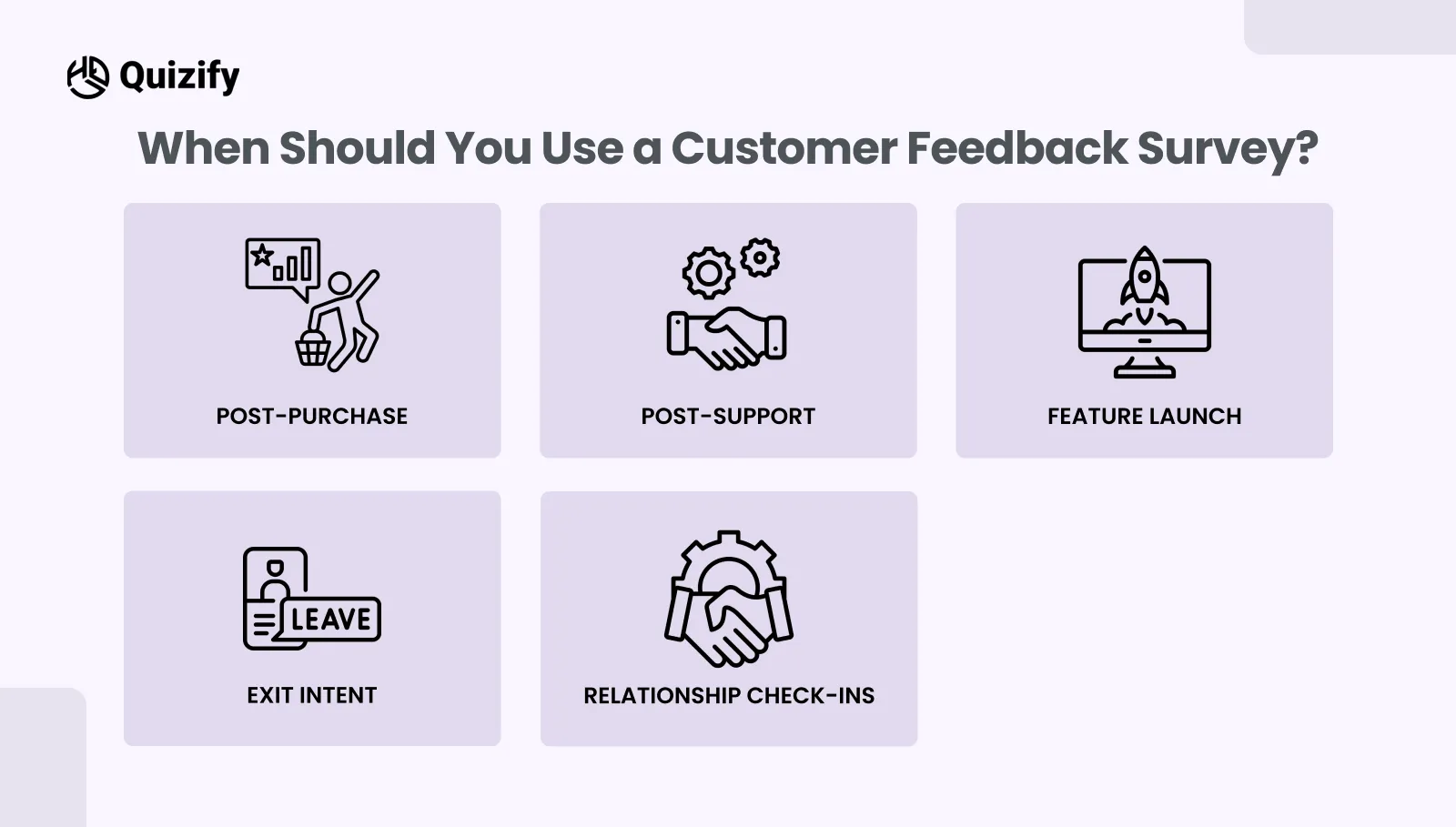
When Should You Use a Customer Feedback Survey?
Timing is the whole game.
Send a survey when the moment is fresh and you will get real answers. Send it days later and people either ignore it or guess.
Here are the moments that usually work best:
Right after a purchase
Ask if checkout felt smooth, if anything was annoying, and whether the product matched what they expected.Right after support closes a ticket
Not “how was our support,” but simple stuff like: did we actually solve it, was it clear, and did it take too long.After a feature launch or a noticeable change
This is where you catch surprises fast. Did the update help, or did it create new confusion?On exit, when someone is about to leave your site
Keep it short. One question is enough. What stopped you? What were you looking for?Quick relationship check-ins
These are the small pulse surveys that tell you if satisfaction is holding steady or quietly dropping.
Common Customer Feedback Survey Use Cases
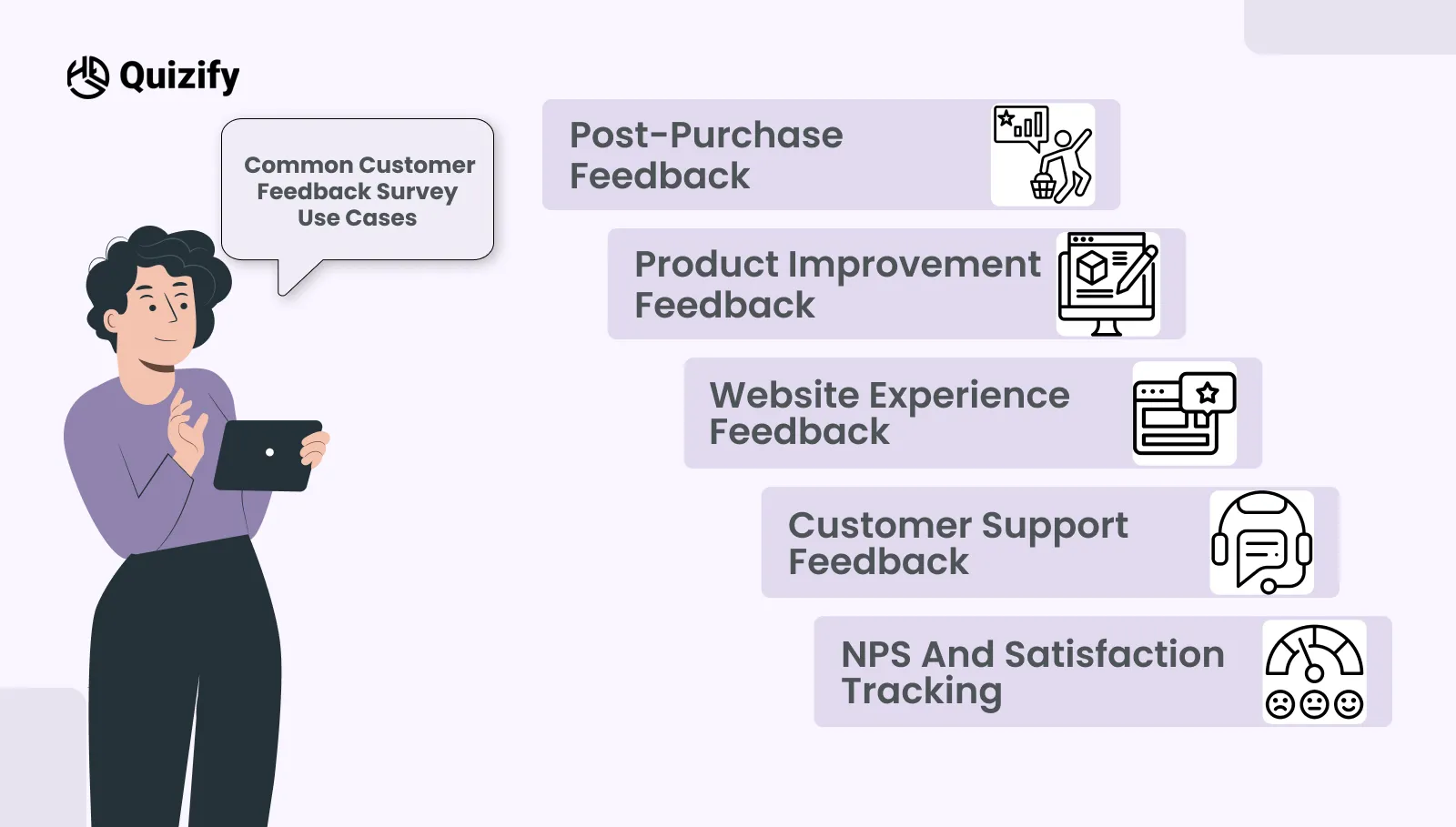
Most teams use feedback surveys for a few repeatable jobs:
Post-purchase feedback
Learn what pushed them to buy, what almost blocked the purchase, and what would make the next one easier.Product improvement feedback
Collect feature requests and usability pain points from real users, in their own words.Website experience feedback
Find the “why” behind drop-offs. Where did people get stuck? What felt unclear? What did they not find?Customer support feedback
Measure the experience after help is given. Speed, clarity, and whether it actually solved the problem.NPS and satisfaction tracking
Track loyalty over time, and separate net promoters from passives and detractors so you know where to focus.
Customer Feedback Survey Question Examples That Actually Work
Good feedback comes down to good questions. If the questions are vague, you will get vague answers. If they are too long, people will rush. The sweet spot is simple, specific, and easy to answer.
Here are a few question examples you can use (and tweak) depending on what you are trying to learn.
Satisfaction questions
How would you rate your overall experience?
Did our product or service meet your expectations?
Experience-focused questions
What felt unclear or frustrating?
What worked better than you expected?
Product feedback questions
Which feature do you use most often?
What do you wish we offered that we do not today?
Support feedback questions
Was your issue resolved in a reasonable time?
What could we do to improve our support experience?
Open-ended questions
Is there anything you want to tell us that we did not ask?
What would make your next experience better?
A mix of quick rating questions and one or two open-ended prompts usually gives you the best insight without making the survey feel heavy.
How to Create a Customer Feedback Survey Using Quizify
You do not need to overthink it. Most teams build a solid survey in a few quick steps:
Pick a feedback template or start from scratch
Add your questions, then set up conditional logic where it helps
Match the survey to your branding
Share it as a link, send it by email, QR code or embed it on your site
Review responses as they come in and watch for patterns
In most cases, the whole setup takes under 15 minutes.
Benefits of Using Quizify for Customer Feedback Surveys
Collecting feedback is not the hard part. Most tools can do that.
The hard part is getting feedback people actually finish, and then turning those responses into something your team can use.
That is where Quizify helps. Instead of giving you another long form builder, Quizify helps you run feedback surveys that feel simple on the customer side and useful on the business side. The surveys feel interactive, they do not waste time, and you can act on what you learn faster.
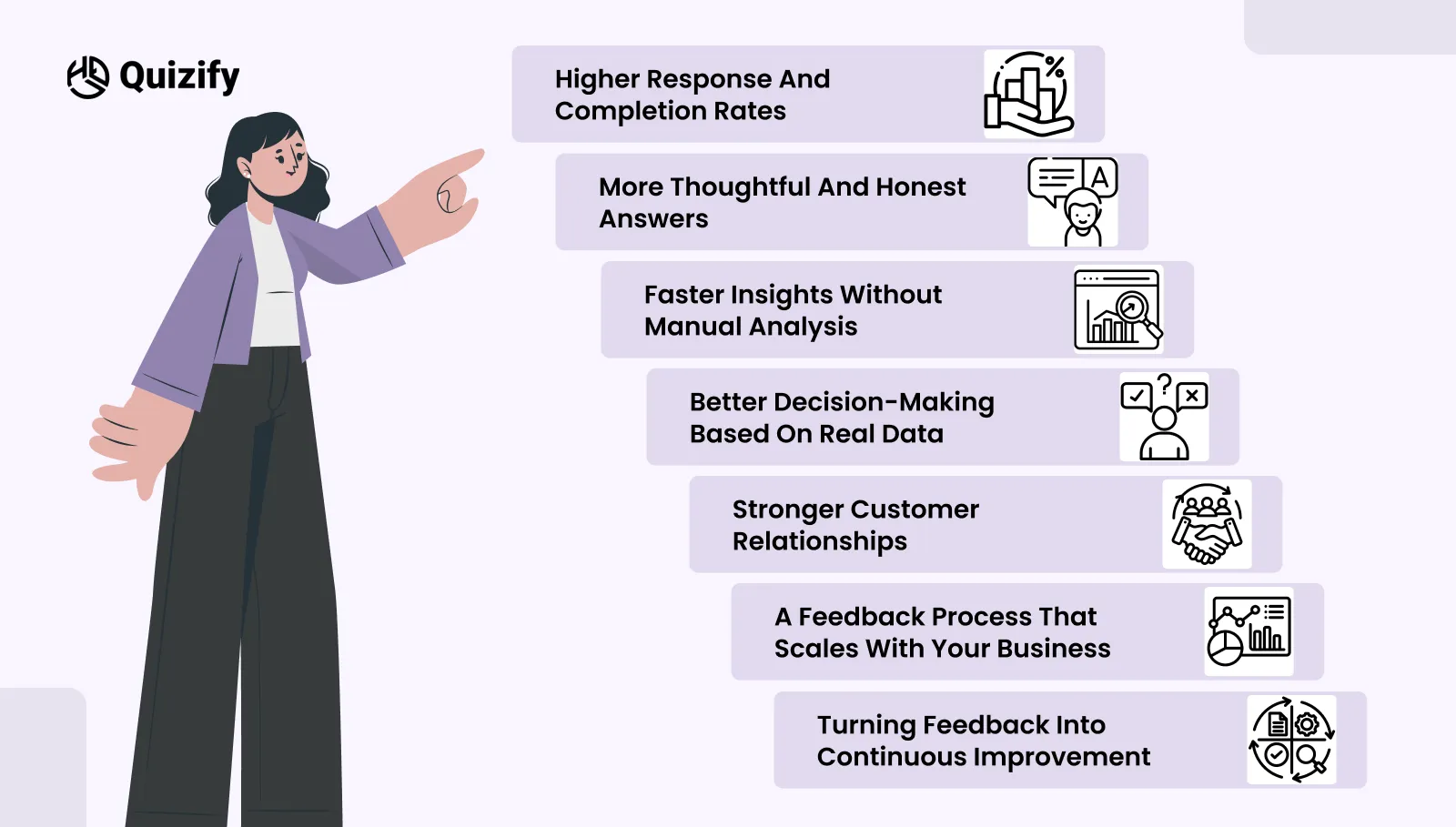
Here are a few of the biggest benefits teams see when they use Quizify for customer feedback surveys.
Higher Response and Completion Rates
Low participation is a common problem with feedback surveys. When a survey looks long, feels repetitive, or is annoying on mobile, people drop off fast.
Quizify improves this by making surveys feel lighter. Questions appear one at a time, so customers are not staring at a long page of fields. It feels more like answering a few quick questions than filling out a form.
Because the survey experience is easier:
More customers are willing to start
Fewer people quit halfway
Completion rates improve without constant reminders
And when more people finish the survey, your feedback reflects real customer sentiment, not just the loudest customers or the ones with extreme opinions.
More Thoughtful and Honest Answers
People rush through surveys when they feel bored, overwhelmed, or like the questions do not apply to them. That is when you get shallow feedback that does not explain what actually happened.
Quizify’s survey flow slows things down in a good way. Because it feels like a short conversation, customers are more likely to answer properly. And with logic-based questions, they only see what is relevant to them, which keeps the experience focused.
As a result:
Feedback feels more personal
Customers share context, not just a rating
Open-ended answers become more useful
This makes it much easier to understand why a satisfaction score is high or low, and what you can do to improve it.
Faster Insights Without Manual Analysis
Feedback should not turn into a spreadsheet project. But that is what happens with a lot of tools. You collect responses, export them, clean the file, then try to figure out what is actually going on. By the time you spot a pattern, you are already late.
Quizify keeps things simple. Responses are organized as they come in, so you can see what customers are saying without doing hours of manual work.
That means:
You can catch issues earlier
Repeating problems are easier to spot
You spend less time sorting data and more time fixing what matters
It is a faster path from “we got feedback” to “we know what to do next.”
Better Decision-Making Based on Real Data
When decisions are driven by internal opinions, you usually end up debating instead of improving. And even when you move fast, you can still miss what customers actually care about.
Customer feedback surveys give you something better than guesses. You hear directly from the people using your product or service, in the moments that matter.
Quizify helps you collect that feedback in a structured way, so it is easier to use in real decisions. Whether you are fixing onboarding, tweaking a feature, or improving support, feedback becomes an input you can trust.
Better decisions happen when:
Product changes match what customers are asking for
Experience improvements focus on real friction, not assumptions
Your priorities line up with customer expectations
Over time, you get steadier progress and fewer “we built this but nobody wanted it” mistakes.
Stronger Customer Relationships
A survey alone does not build trust. What builds trust is what you do after the survey.
When customers feel ignored, they stop sharing feedback. When they see their input taken seriously, they lean in. They respond more often. They stay longer.
Quizify makes it easier to close the loop, whether that means following up with the customer, fixing a recurring issue, or making improvements that customers can actually notice.
Stronger relationships form when:
Customers feel heard, not processed
Feedback turns into visible improvement
Communication feels like a two-way exchange
At that point, feedback stops feeling like data collection and starts feeling like a real conversation.
A Feedback Process That Scales With Your Business
As a business grows, feedback usually starts getting split up across tools and teams. Quizify gives you one setup that can handle it, whether you are collecting feedback from a small group of customers or a much larger base.
That consistency helps you keep the process clean as you scale.
Turning Feedback Into Continuous Improvement
The real win with Quizify is not just collecting feedback. It is using it without the process feeling heavy.
When feedback is easy to collect, easy to review, and easy to act on, teams are more likely to do it regularly. Over time, this turns feedback into a simple loop. Customers share what is not working, you improve it, and the experience gets better.
It becomes part of how the business runs, not something you remember to do once in a while.
And when surveys are quick and easy, customers do not mind answering them.
Who Should Use Customer Feedback Surveys?
Customer feedback surveys are useful in almost any industry. If customer experience matters to your business, feedback helps.
Whether you serve thousands of users or a smaller set of high-value customers, surveys help you see what is working, what is not, and where people feel stuck. Below are some of the teams that get a lot of value from running feedback surveys regularly.
SaaS Companies Focused on Retention and Growth
In SaaS, people do not usually rage-quit. They just stop showing up. Then they cancel.
Most of the time it is not one big problem. It is onboarding that feels messy. A feature that is hard to figure out. A workflow that takes too many steps.
A simple feedback survey helps you catch that early.
Use it to:
Learn why users stick around, or why they are thinking of leaving
Fix onboarding and first-use confusion
Check if a release actually helped, or made things worse
Find the screens or steps where users get stuck
If you are wondering when to ask, keep it simple: right after onboarding, after someone uses a key feature, and when renewal is coming up. That is when answers are the most honest.
Ecommerce Brands Optimizing Conversion and Loyalty
Ecommerce is full of silent drop-offs. People browse, add to cart, then disappear. And most of the time you do not know why.
A quick feedback survey can tell you what analytics cannot.
Customer feedback surveys help ecommerce brands:
Find out what stopped checkout (shipping cost, payment issues, trust, confusion)
Understand why carts get abandoned
Fix weak product pages (missing info, unclear sizing, bad visuals)
Check how customers felt after the product arrived
If you ask right after purchase or delivery, you get real answers instead of vague ones.
Agencies Measuring Client Satisfaction
Agency work can look fine on the surface even when the client is slowly getting frustrated.
Feedback surveys help you catch that early, before it turns into “we are going to pause work” or “we are switching agencies.”
Customer feedback surveys help agencies:
Keep a pulse on satisfaction across projects
Spot communication gaps and expectation mismatches
Improve delivery and collaboration
Strengthen trust and retention
Regular check-ins keep things clear and reduce surprises.
Coaches and Consultants Refining Their Services
For coaches and consultants, tiny details matter. If onboarding is messy or sessions feel unclear, results suffer.
Feedback surveys help you tighten everything up.
Customer feedback surveys help coaches and consultants:
Learn what clients find most valuable
Improve session structure and delivery
Fix onboarding and communication
Identify where clients need extra support
It is a simple habit that makes your service better over time.
Product Teams Validating Roadmap Decisions
Analytics tell you what users did. They do not always tell you why.
A feedback survey helps you get the reason behind the behavior, especially when you are deciding what to build next.
Customer feedback surveys help product teams:
Validate ideas before you build them
Understand feature adoption and everyday usage
Prioritize the roadmap based on real input
Avoid spending time on the wrong work
Pair that feedback with product analytics and you get the full picture: what users did, and why they did it
Customer Support Teams Improving Response Quality
Support shapes how customers feel about your business. One bad support experience can undo a lot of good work.
Short feedback surveys right after a ticket is resolved are a simple way to see what is working and what is not.
Customer feedback surveys help support teams:
Measure satisfaction after support interactions
Identify training or process gaps
Improve response time and clarity
Recognize support agents who consistently do a great job
Post-resolution surveys are quick for customers, but the insight you get is valuable.
Any Team That Cares About Customer Experience
Customer feedback surveys are not limited to one industry or company size. If your business depends on customer experience, feedback matters. It helps you see what is working, what is frustrating, and what needs attention.
When feedback becomes part of regular decision-making, teams respond faster and make fewer assumptions. It stops being a one-time activity and becomes part of how the business runs.
If experience affects retention, revenue, or reputation, feedback surveys belong in your process.
Start Listening to Your Customers Today
Your customers are already forming opinions about every interaction with your business.
Collecting feedback at the right moments helps you understand those experiences clearly. Instead of guessing what needs improvement, you can base decisions on what customers actually say.
Similar Topic
Free Customer Feedback Survey Template
Getting started does not have to be complicated.Quizify includes a ready-to-use customer feedback survey template so you do not have to build one from scratch. It is designed to:



FAQ
Frequently Asked Questions
What makes a good customer feedback survey?
A good survey is clear, short, and relevant to the moment. It asks questions that customers can answer quickly and honestly.
How long should a customer feedback survey be?
In most cases, under two minutes is ideal. Shorter surveys usually see better completion rates.
Can customer feedback surveys improve retention?
Yes. When teams act on feedback consistently, customers are more likely to stay.
Is Quizify suitable for small teams?
Yes. It works for small teams and scales as your customer base grows.
Do customer feedback surveys work on mobile?
Yes. Surveys built in Quizify are designed to work smoothly on mobile devices.