Customer Insight Survey
18 Min Read
Gather valuable feedback from your customers to better understand their needs, preferences, satisfaction, and overall experience. Use these insights to improve your products, services, and customer relationships.

Executive Summary
Customer Insight Survey was just a simple way to ask for feedback before. But, it has been turned into a powerful strategic growth tool that enables a company to delve into why customers do certain things rather than simply what they do.
Today's companies are surrounded with an ever-changing customer expectation environment. People will not accept generic experiences anymore.
They want personalization, meaningfulness and value without delay. That's why the traditional survey would not be able to serve the purpose as they are only capable of gathering static answers without understanding the deeper human context.
So, customer insight-driven systems are those that really matter.
Now, firms employ smart survey funnels like Quizify to turn a simple way of collecting feedback into rich, interactive, and data-driven experiences.
They do not simply ask straightforward questions , instead, businesses create guided experiences with Interactive Quiz Funnels that change based on the user's behavior.
Using tools such as AI Quiz Builder and AI Funnel Creator, companies craft intelligent surveys that not only gather data but also segment users, generate leads, and set off personalized workflows.
The features of a modern Customer Insight Survey include:
Having an in-depth understanding of the customers' behavior
Being able to convert insights to tangible business tactics
Implementing automation to deliver personalized experiences on a large scale
This leads to a transformation from "data collection" to "decision intelligence".
Challenges in Traditional Customer Insight Collection
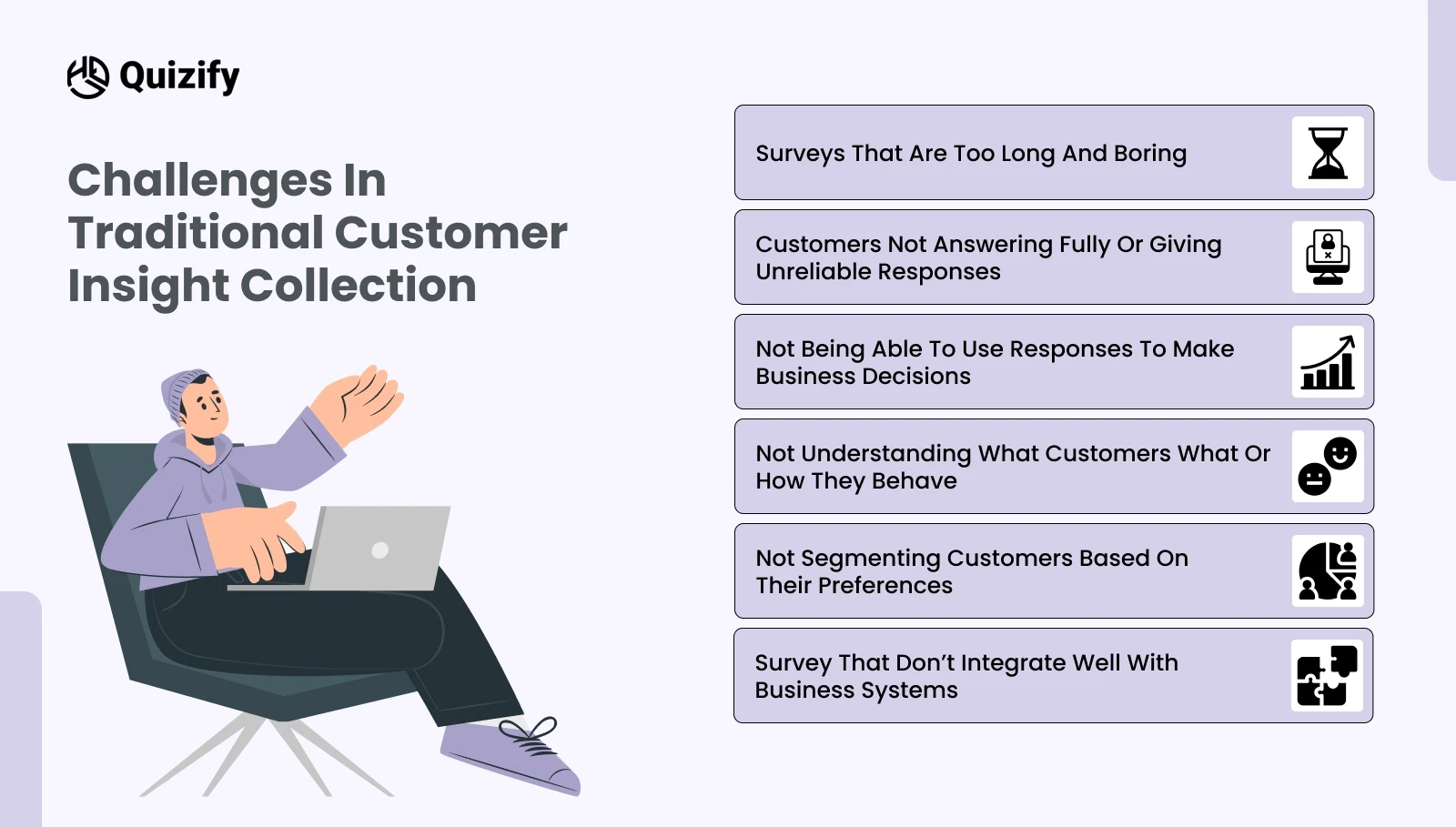
Businesses today have a lot of customer data. Having a lot of data does not mean you really understand what is going on.
Many companies are still trying to figure out what customers really want. They want to know why customers do things and how that affects the business.
The problem is not that there is no information. The real problem is making sense of all the information that's out there. Businesses need to turn all the things that customers say into something that they can actually use.
The old way of doing surveys is not very good. These surveys just ask questions. Do not really try to understand what customers are doing. They feel like chores and people get bored with them before they are even finished.
Some of the problems that businesses have include:
Surveys that are too long and boring
Customers not answering all the questions or answering them in a way that does not make sense
Not really understanding what customers want or how they behave
Not being able to use the answers to make business decisions
Not being able to group customers together based on what they like
Surveys that do not work well with business systems
Another major problem with these old surveys is that they consider all customers as one group without any distinction, i. e. they ask the same set of questions even when different customers are interested in different things.
To close the gap, companies are now choosing for smart systems based on Conditional Logic and Logic Jumps, which allow the question flows to be dynamically changed per the user responses.
From Static Forms to Intelligent Experiences
Customer insight strategies today focus more on engagement rather than interrogation.
In place of static questionnaires, enterprises create adaptive journeys with the help of Conversational Forms and Interactive Quiz Funnels.
A solid survey strategy includes:
Defining customer behaviour goals (not just data points)
Designing adaptive question flow
User segmentation in real-time
Behavioural signals, not just answers
CRM and marketing tool integration of results
The No-Code Quiz Builder tool helps businesses quickly build smart survey flows without having to bring in a developer.
The concept is simple, but it can make a big difference.
Traditional Customer Surveys | Modern Customer Insight Surveys |
Static questions with fixed response paths | Dynamic and adaptive flows powered by Conditional Logic |
Manual data analysis that takes a lot of time | Automated insights with real-time behavioral tracking |
Generic results for all users | Outcomes based on customer responses |
Low engagement and high drop-off rates | Interactive experiences that improve participation |
One-way feedback collection | Conversational and insight-driven survey journeys |
Limited audience understanding | Deep customer preference analysis |
Basic lead collection forms | Intelligent Lead Generation Funnels with segmentation |
No personalization within surveys | Customized experiences using Logic Jumps |
Difficult CRM and marketing integration | Connected workflows through CRM Integrations and automation |
Static reports with limited actionability | Actionable insights powered by Quiz Analytics and Behavioral Analytics |
Surveys no longer just collect responses and feedback from customers, surveys will become a tool for building relationships through ongoing use of surveys by companies.
How Modern Customer Insight Surveys Work
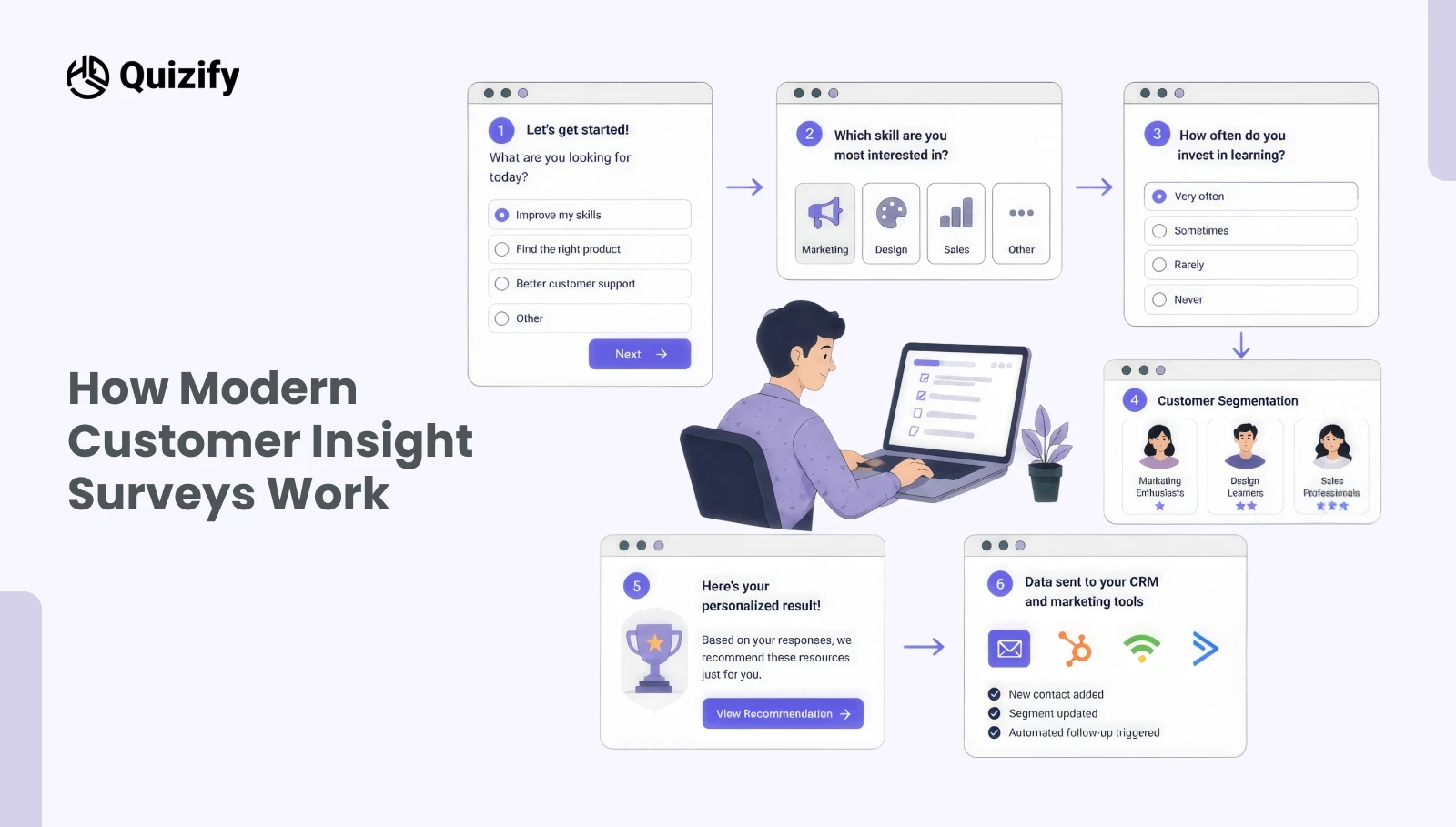
Businesses want to understand what customers think, feel, and do. They also want to know why customers make certain decisions and how those actions affect sales and customer loyalty.
To do this companies are now using smarter surveys that adjust based on customer responses. These surveys are not just forms that ask the same questions to everyone. They are like conversations that change based on what the customer says.
Companies use tools like Quizify to make these surveys. They have features like a quiz builder and a funnel creator. These features help make the survey feel like a conversation. The survey asks questions. Then changes based on the answers.
Here is how it works:
The customer starts the survey. It asks them some questions to see what they want.
The survey then changes based on what the customer says. It asks questions to different people.
The customer is then put into a group with people who are like them.
At the end of the survey the customer gets a message just for them.
The company then uses that information to follow up with the customer.
This way of doing surveys helps companies understand their customers better. It also makes the survey more fun, for the customer.
Companies do not just use surveys to get feedback. They use them to learn about their customers and to make decisions. The idea is easy to understand. It can make a big difference.
Key Findings from Customer Insight Surveys
By effectively using customer insight surveys, businesses realize they discover things that ordinary surveys don't usually reveal.
They help businesses figure out customers' expectations, decision-making factors, and where customers disengage during the survey.
There are many users who simply dislike lengthy forms with repetitive questions. People, in general, respond better when the survey is perceived as being quite simple, relevant, and easy to continue.
Questions that are in line with the users' interests increase the probability that they will finish the survey and give honest answers.
Typically, the major findings that some businesses identify are:
People appreciate individualized offers more than general recommendations
Customers are more likely to fill out surveys when the flow keeps them interested
If surveys have unrelated questions, users drop out
Encouraging question flows result in more reliable answers
Audience segmentation is a key to better targeting and higher conversions
Interactive surveys are a good way to attract more participants and keep them engaged
Besides, Quiz Analytics allows businesses to follow users' movements in the survey and oversee their behavior live.
Also, Funnel Insights indicate at what points the users begin to lose interest while Drop-Off Tracking points out sections which may need a revision.
This enables businesses to enrich the survey experience and make decisions based on actual customer behavior rather than on guess.
Turning Responses into Strategy
One of the most powerful outcomes of a Customer Insight Survey is segmentation. Rather than treating all their customers the same, companies divide them into different groups per their behavior, intent, and preferences.
Some typical segmentation types are:
Highly-motivated customers
Users who do a lot of research
Users who are sensitive to prices
Users who want a good experience
With Audience Segmentation, businesses can automatically categorize users from their survey answers.
It will help them to perform very precise actions like:
Sending personalized emails
Recommending products
Providing customized onboarding processes
Doing personalized sales interaction
From Responses to Revenue Insights

Nowadays it is simple to collect customer data. The tough part is figuring out what the data actually means and how companies can use the information to enhance customer experience, engagement, and conversion.
Today's survey platforms not only gather the answers; they also enable companies to observe the users' interaction with the survey. Because of this, companies get a better understanding of what interests the customers, when they get bored, and the most probable actions they will do.
With the help of Behavioral Analytics and Quiz Analytics, companies can follow customer behavior and recognize response tendencies live.
Among the key factors that companies monitor are:
Completion rates throughout the survey
Customer response patterns
Conversion performance
User engagement behavior
Funnel drop-off points
The analysis of these factors allows companies to optimize the performance of the survey and to adjust the whole experience that is more suited to the users.
Analytics features and their business impact are explained below in a simple way:
Analytics Feature | Meaning |
Quiz Analytics | Makes it easier to understand how users interact with the survey |
Funnel Insights | Shows the stages where users enter or leave the funnel |
Drop-Off Tracking | Reveals the parts of the survey where users lose attention |
Conversion Analytics | Tracks how the survey helps in lead generation and conversions |
Behavioral Analytics | Helps identify customer interests and intent |
Once they only collected feedback through surveys, businesses nowadays use them as a tool for feedback collection, businesses now use them to continuously improve customers.
Business Impact of Customer Insight Surveys
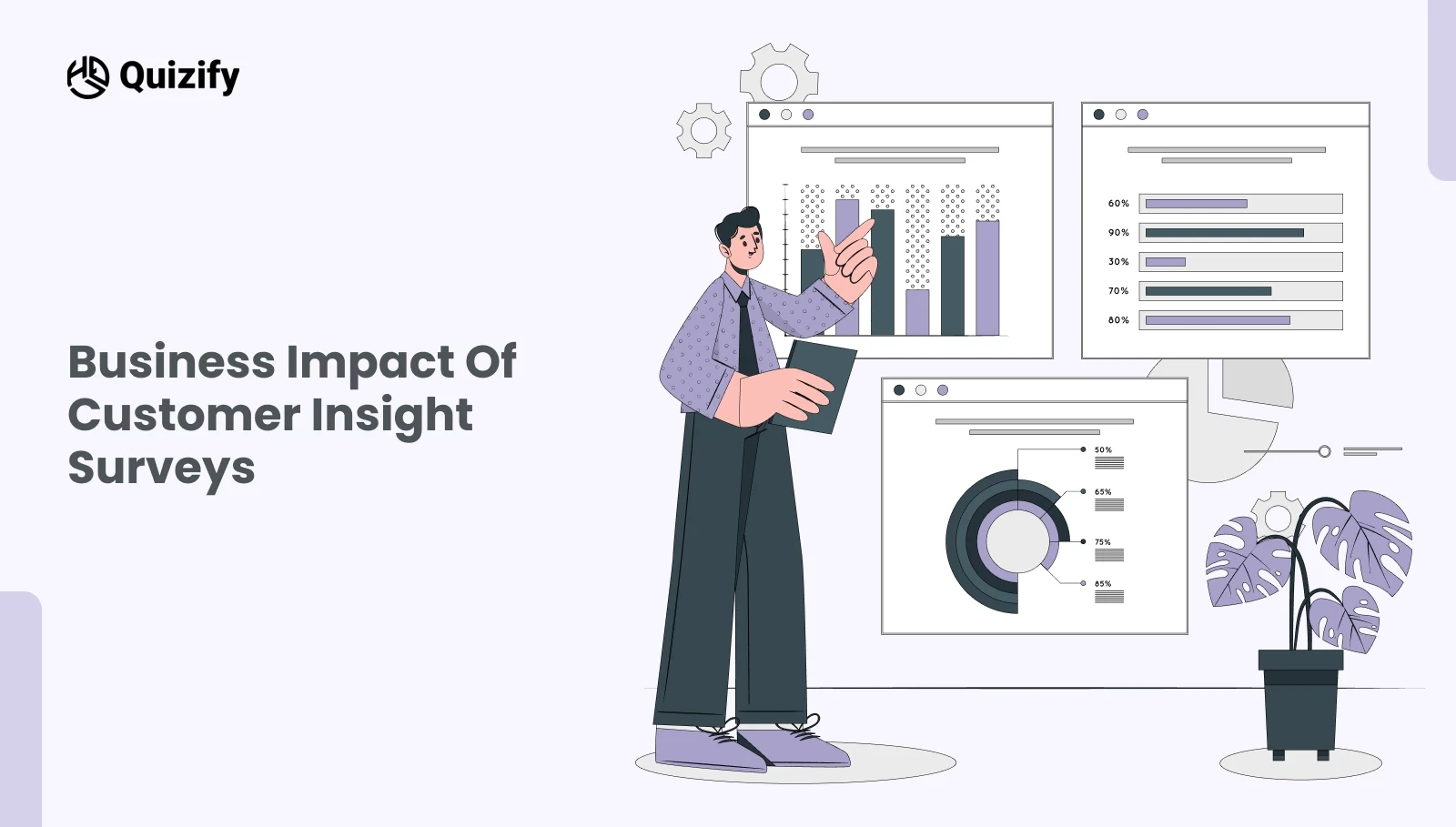
Using Customer Insight Surveys in proper ways helps to grow your business in a direct way. These surveys are not just for collecting survey responses; they provide businesses with better insights into their users and allow them to take actions that have an impact on their outcomes.
Some major advantages include:
Greater engagement levels due to the more interactive nature of surveys.
Lead capture forms ensure better-quality leads. Through audience segmentation, marketing efforts become more targeted.
Personalizing user experiences results in higher conversions. Customer feedback obtained directly enables quicker product-related decision-making.
Also, connect your survey with other tools such as:
HubSpot
Mailchimp Klaviyo
Zapier Google Analytics
Facebook Pixel WhatsApp
Calendly
These integrations make surveys a part of a complete system instead of a set of separate tools. Customer data is being shared more seamlessly among marketing, sales, and product teams.
Best Practices for Building Customer Insight Surveys Companies should continuously strive to make their surveys concise, and user-friendly. Examples of things one can do to reach the target include:
Keep surveys short and focused Use Logic Jumps to avoid unnecessary questions
Personalize survey flow with Conditional Logic Optimize for mobile users
Improve engagement with Video-Based Quizzes Make result pages useful and relevant
Connect surveys with automation tools Ignoring common pitfalls such as this is a must:
Asking too many questions Using generic result pages
Ignoring mobile experience Not sending follow-up communication
A well-made survey resembles the natural flow of a conversation, making the respondent want to keep going. Conclusion
Customer insight surveys have gone beyond just the feedback collection tool. They have become a channel through which businesses understand their customers' behavior, enhance the user experience and shorten the time to making better business decisions.
Conclusion
Customer Insight Surveys are not just for collecting feedback. Businesses use them to understand how customers behave, make their experiences better and decide faster.
Companies want to know what customers think and why they think that way. They also want to know how to respond in a way.
Surveys can be made interesting and useful with tools like AI Funnel Creator, AI Quiz Builder, Interactive Quiz Funnels, Dynamic Result Pages, Quiz Analytics, Email Automation and CRM Integrations. Businesses can use these tools to turn surveys into engaging experiences.
The future is, for businesses that can put customer data, personalization and automation together in one system.
Similar Topic
Free Customer Feedback Survey Template
Getting started does not have to be complicated.Quizify includes a ready-to-use customer feedback survey template so you do not have to build one from scratch. It is designed to:



FAQ
Frequently Asked Questions
Is a Customer Insight Survey hard to set up?
Not really. Using a No-Code Quiz Builder you can create a customer insight survey fast and easily without any programming skills.
How long should a survey be?
Short and simple surveys get better results that are even more noticeable when you use an AI Quiz Builder with user-friendly business logic.
Do users actually complete these surveys?
It makes a big difference to complete rates if you make it look and feel like an Interactive Quiz Funnel instead of a long form.
Can surveys work without technical skills?
Yes, tools like AI Funnel Creator helps you sketch out complete survey experiences without even touching code.
When should a survey be shown to users?
Best results come when surveys are triggered after meaningful actions using Lead Capture Forms.
Can surveys be used on mobile?
Most modern Conversational Forms are designed to work smoothly on mobile devices.
Can survey data connect with other tools?
Survey results can sync with systems through CRM Integrations like HubSpot or Mailchimp.
Are survey results automated?
Insights are generated automatically using Quiz Analytics, so no manual work is needed.
Can surveys help with marketing?
They help improve targeting through Audience Segmentation based on user responses.
Are surveys suitable for small businesses?
Small businesses often use Lead Generation Funnels to collect and qualify leads easily.