Occupational Aptitude Test
18 Min Read
Need help choosing the right career? Learn how occupational aptitude tests identify strengths, skills, and suitable career paths easily.
Choosing an occupation is one of life’s most critical occurrences. It impacts your financial status, personal satisfaction, sense of self-worth, daily tasks, and long-term life satisfaction.
However, many individuals make this decision without a clear understanding of their skills, how they will use them in a job, or whether a particular type of employment fits their personality traits.
A lot of students make career choices based on academic results, peer influence, parental expectations, or a temporary interest. As they progress, many realize their choice does not match their thinking or personality style. This leads to confusion, dissatisfaction, and often career changes.
An Occupational Aptitude Test helps eliminate uncertainty and provides a clear understanding of the types of jobs that suit one’s natural capabilities and true potential using interactive career assessment tools.
For example:
An Occupational Aptitude Test identifies the types of work your mind is naturally suited for.
In addition, companies like Quizify use technology to create quick, simple interactive quizzes and AI-powered assessment tools that provide immediate career insights based on individual aptitudes.
What is an Occupational Aptitude Test?
An Occupational Aptitude Test (OAT) is a cognitive and psychological assessment of a person's aptitudes, reasoning ability, problem-solving ability, and decision-making style in relation to an occupational career path.
Unlike a standard academic assessment, which assesses what someone has memorized, an OAT does not evaluate your ability to recall facts. Instead, an OAT evaluates your ability to process and use information in real-life scenarios as part of problem-solving often through online assessment platforms.
An OAT measures the following:
Your speed in understanding problems
Your ability to think in terms of logic vs. creative thinking
How well you are able to work with numbers or words
Your ability to recognize patterns
How quickly you make decisions
How you perform in workplace-type scenarios
The intent of an OAT is not to label intelligence; it is meant to help determine which careers best fit the aptitudes or interests of the individual.
Your answer to this question will be your OAT results, and the answer is:
"Which occupations naturally fit my thinking style and my abilities?"
Modern technology platforms like Quizify, which use an AI quiz maker and AI survey maker, have made it possible for users to take OATs in less time and find the appropriate career that meets their skills and interests.
Why Occupational Aptitude Tests Are Important in Today’s World
The modern job market is extremely dynamic. New industries are emerging every year, and traditional career paths are evolving rapidly. With so many options available, individuals often feel overwhelmed and uncertain about which direction to choose.
Many people struggle with:
Lack of clarity about career goals
Choosing wrong academic streams
Switching jobs frequently
Feeling stuck in unsuitable roles
Not understanding personal strengths
Occupational aptitude tests solve this problem by providing structured clarity, especially when delivered through smart assessment tools and interactive quiz platforms.
They reduce career confusion
Instead of exploring thousands of job roles blindly, aptitude tests narrow down suitable options based on actual abilities.
They reveal hidden strengths
Many individuals discover skills they were not aware of, such as analytical thinking, spatial awareness, or verbal reasoning ability.
They prevent wrong career choices
Choosing a career without understanding suitability often leads to dissatisfaction and stress. Aptitude tests help avoid this early.
They improve self-awareness
You begin to understand how your brain works rather than just what subjects you enjoy.
They increase long-term career stability
When a job aligns with natural strengths, individuals tend to perform better and stay in roles longer.
Real-life example:
A student who struggles in traditional academics may still perform exceptionally well in logical reasoning tests, leading them toward careers in data analysis, IT, or problem-solving roles.
Platforms like Quizify simplify this process by presenting skill insights in visual dashboards and automated reports that are easy to interpret.
How Occupational Aptitude Tests Work
Occupational Aptitude Assessments are performed according to structured psychological models which assess someone's potential by evaluating cognitive abilities through timed exercises using different types of tests, often built using an AI form builder or assessment templates.
Test structure
An example of an occupational aptitude assessment is as follows:
Numerical reasoning
Verbal comprehension
Logical reasoning
Abstract reasoning
Situational judgement
What is being measured?
The system measures the following:
Accurate responses
Speed of response
Logical consistency
Decision-making methodologies
Problem-solving styles
Result generation process
After the assessment is completed, the system compares your assessment to benchmarked data from different professional populations. Based on your results, the system produces:
Skills Profile
Areas of Strength
Areas for Development
Career recommendations (Generally speaking)
Your suitability for different industries
Role of modern tools like Quizify
Modern tools such as Quizify improve the experience of taking a career assessment test by:
Creating smaller interactive quizzes
Providing real-time feedback
Using gamified design to engage users
Providing visual representations of potential careers
Providing instant personalized reporting using AI-powered insights
Career assessment feels more like a guided exploration than an assessment through modern tools such as Quizify.
Types of Occupational Aptitude Tests
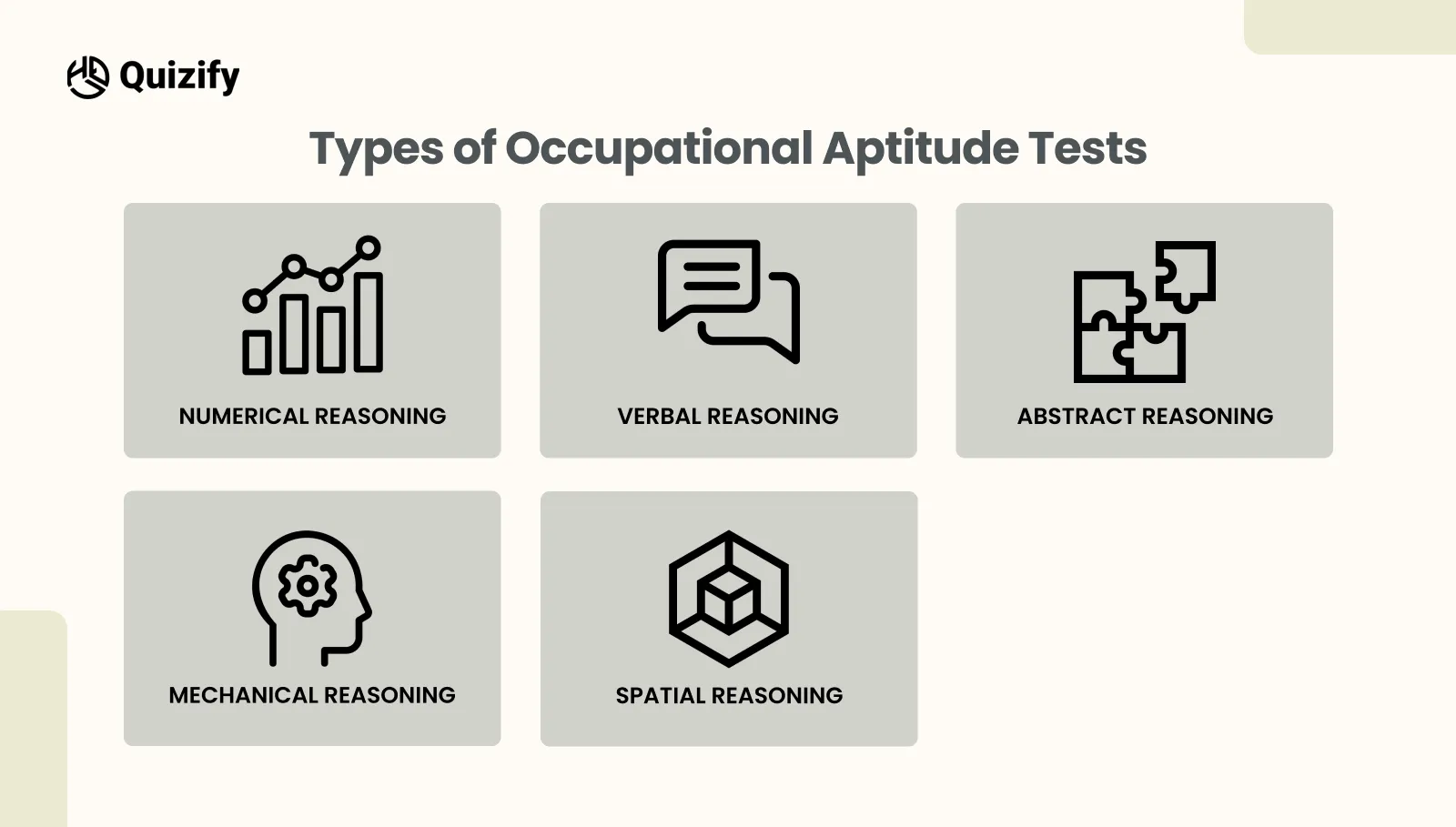
Occupational aptitude tests are divided into several categories, each focusing on a different type of cognitive skill.
Numerical Reasoning Test
Verbal Reasoning Test
Abstract Reasoning Test
Mechanical Reasoning Test
Spatial Reasoning Test
Complete Aptitude Test Overview
Type | Focus | Core Skill | Careers |
Numerical | Data & numbers | Analysis | Finance, Data |
Verbal | Language | Communication | Writing, Law |
Abstract | Patterns | Logic | IT, Consulting |
Mechanical | Physical systems | Technical reasoning | Engineering |
Spatial | Visualization | Design thinking | Architecture |
Who Should Take Occupational Aptitude Tests?
Aptitude tests can be helpful for a variety of people: students choosing career paths; graduates who are entering the job force; professionals who are thinking about changing their careers; people who are unhappy in their current jobs; and anyone who has taken an extended break from employment.
Online services such as Quizify offer mobile-friendly assessment tools, ready-to-use templates, and career-focused use cases, making this important process available to anyone at any time.
There are several benefits to taking an Occupational Aptitude Test:
(1) Provides clear and structured direction so that confusion is maximized.
(2) Saves you time by not letting you waste time on searching for jobs, as an incorrect match will result in you switching jobs several times.
(3) Increases job satisfaction since better matches will result in greater job satisfaction.
(4) Provides an objective basis for making job-related decisions.
(5) Enables students to identify an appropriate degree program before they begin their studies.
Occupational Aptitude Tests are limited in several ways:
(1) A person's passion is not completely measured through the test;
(2) The design of the test itself has a significant bearing on the accuracy of the test results.
(3) The results of the test should not be the only basis for making your career choice.
(4) Actual on-the-job experience must be taken into account.
To prepare for taking an Occupational Aptitude Test, you can:
(1) Practice doing basic math;
(2) Solve logic puzzles on a regular basis;
(3) Improve your reading comprehension skills;
(4) Work on doing the above-mentioned tasks quickly and accurately;
(5) Remain calm when taking the test.
Why Companies Use Aptitude Tests
Companies use these tests because:
They reduce hiring bias
They predict job performance
They improve candidate selection quality
They save recruitment time
They identify high-potential talent
Many organizations now rely on AI assessment platforms and online quiz builders to streamline hiring and evaluation processes.
Real-Life Example
Candidate A: High academic scores but weak logical thinking
Candidate B: Average academic scores but strong problem-solving skills
In many real-world roles, Candidate B performs better because practical thinking is more important than memorization.
Final Thoughts
An Occupational Aptitude Test is a powerful tool for career discovery. It helps individuals understand their natural strengths, thinking style, and suitable career paths.
It does not decide your future — it simply gives direction when clarity is missing.
With modern platforms like Quizify offering tools like AI quiz maker, AI form builder, and AI survey maker, this process has become more interactive, engaging, and accessible than ever before.
Similar Topic
Free Customer Feedback Survey Template
Getting started does not have to be complicated.Quizify includes a ready-to-use customer feedback survey template so you do not have to build one from scratch. It is designed to:



FAQ
Frequently Asked Questions
How long does an Occupational aptitude test usually take?
Most tests are short and structured. They can take anywhere from 15 minutes to about an hour, depending on the platform and the number of sections included.
Can I take an aptitude test more than once?
Yes, you can take it multiple times. Some people retake the test after improving their skills or when they want to check if their results change over time.
Do I need any special knowledge before taking the test?
No special knowledge is required. The test is designed to check your natural thinking ability, not what you have studied or memorized.
Can an aptitude test be helpful if I already have a job?
Yes, it can still be useful. It can show whether your current role matches your strengths or help you explore better career options.
What should I do after getting my test results?
Use the results as a guide. Look at the suggested career options, compare them with your interests, and explore those fields before making any decision.