Personality Test
18 Min Read
Personality tests help businesses understand user behavior, create engaging quizzes, and collect useful customer insights with Quizify.
Personality tests are used across many industries, but most of them have one common problem—people do not finish them. They start the quiz and leave halfway because it feels too long, repetitive, or hard to follow. This affects both the experience for the user and the quality of data collected.
A good personality test does not have to be complicated. It should be clear, structured, and easy to move through from start to finish. When it is built the right way, it helps users learn something useful about themselves and gives businesses the kind of information they actually need.
In this blog, we will cover how personality tests work, where they are commonly used, and what it takes to build one that people actually complete. We will also look at how tools like Quizify make it easier to create better and more structured quizzes.
What Is a Personality Test?
A personality test is a set of structured questions that helps understand how a person thinks, behaves, and makes decisions. It looks for patterns in answers and links them to traits like communication style, decision-making ability, or work preferences.
In a personality quiz, each question comes with a few options. Each option reflects a different type of behavior. When someone picks their answers, the system builds a result based on those choices and shows their personality traits.
To keep it simple, here is the basic structure of a personality test.
Element | Description |
Questions | Collect user responses |
Options | Represent behavior types |
Logic | Connects answers to outcomes |
Results | Shows personality insights |
This structure keeps personality tests easy to build and simple for users to complete without confusion.
Why Personality Tests Are So Popular?
Personality tests are popular because they’re simple and interactive. A personality quiz doesn’t feel like filling a form. People usually continue because they want to see what result they get.
Many users also prefer quick insights about themselves. A good quiz gives short feedback on behavior, preferences, or strengths instead of long explanations. That feels easier to relate to.
For businesses, personality quizzes are useful for understanding users without asking direct questions. Behavior patterns give enough signals to read intent.
Some reasons they work well:
Interactive experience instead of static forms
Results that feel personal
Higher completion rates than surveys
Better quality of user data
Tools like Quizify use a one-question flow. It keeps things simple and reduces drop-offs.
Where Personality Tests Are Used?
Personality tests are used in different areas depending on the goal. The structure stays the same, but the use changes from one case to another.
In recruitment, they are used to understand candidate behavior, communication style, and team fit. It’s not just about what is written in a resume, but how a person may actually work in a team.
Marketing uses personality quizzes mainly for lead generation. A user answers a set of questions, gets a result, and in many cases shares basic details to continue.
In education, personality assessment tests are used for career guidance. They help students understand their strengths and preferences so they can make clearer decisions about their future.
The table below shows the main areas where personality tests are commonly used.
Use Case | Purpose |
Hiring | Evaluate candidates |
Marketing | Generate leads |
Education | Career guidance |
E-commerce | Product recommendations |
This is why personality tests are used across different industries.
Common Problems with Personality Tests
Most personality tests fail due to improper design. Often, there are too many questions, leading to lower completion rates and user disengagement. Questions are not worded well, so users may not understand them due to complexity or lack of clarity.
This leads users to skip questions or choose answers at random, which creates inaccurate scores and poor data points. Additionally, users receive very similar results, making the tests feel generic and not valuable in providing useful and personalized content.
Most often these problems are caused by a few patterns:
Too many questions
Poorly worded questions – Lack of clarity on the question
Lack of personalization – Users receiving virtually identical results
No follow-up after completion of the test
Each of these factors leads to lower user engagement and less business value. A successful personality test creates value by being easy to engage with, concise, and directly related to individual personality characteristics.
What Makes a Personality Test Effective?
An effective personality test focuses on clarity, structure, and relevance. Each question should be simple and directly connected to the purpose of the quiz. This improves both understanding and response quality.
The flow of the quiz should feel smooth. Users should move from one question to the next without confusion. This helps maintain engagement.
The result is the most important part. It should feel personal and provide useful insights, not just a label.
Here’s what actually makes a personality test work well in practice:
Clear and simple questions
Logical flow between questions
Personalized and meaningful results
Purpose-driven data collection
When these elements are combined, a personality quiz becomes both engaging and useful.
How Quizify Helps in Creating Personality Tests?
Building a personality test from scratch takes a fair amount of time and effort. Quizify makes that process simpler by giving you the tools to build structured and interactive quizzes without starting from zero.
You can create questions, arrange them in order, and design the full quiz without needing any technical skills. The platform is straightforward to use and cuts down the time it takes to get a quiz ready.
Quizify also lets you set up Dynamic result pages, so users get results that feel relevant to them rather than a generic response that could apply to anyone.
Here is what Quizify offers to make personality test creation easier:
Easy quiz creation interface
Support for multiple question types
Custom result pages
Built-in lead capture
These features help you build a personality quiz that keeps users engaged and delivers results that actually mean something.
Using Logic to Improve User Experience
Conditional logic is one of the most important parts of a personality test. It controls how the quiz changes based on user responses.
Instead of showing the same questions to everyone, logic lets the quiz adjust as the user moves forward. This keeps the questions relevant and avoids asking things that are not needed.
In Quizify, you can set up logic-based flows without much effort. Each answer can lead to a different question, so the experience feels more personal.
This is how logic improves the overall quiz experience:
More relevant questions
Shorter and focused quizzes
Better user engagement
Improved completion rates
Using conditional logic helps keep users interested and makes it more likely they will complete the quiz.
Lead Collection and Follow-Up
The main purpose of personality tests is to collect leads, but this should happen in a natural way. When users see value in a test, they are more likely to share their information.
With Quizify, you can include lead capture forms at different points in the quiz. By then, users are already engaged, so sharing their information feels more comfortable.
Once you have collected user data, it’s important to use it properly. Follow-ups through email or text messages help build connections and improve conversion rates.
A typical lead flow looks like this:
User takes your test
User answers questions
User receives partial results
User enters their information
User receives full results
This process makes lead collection more smooth and effective.
Integrations That Make the Process Easier
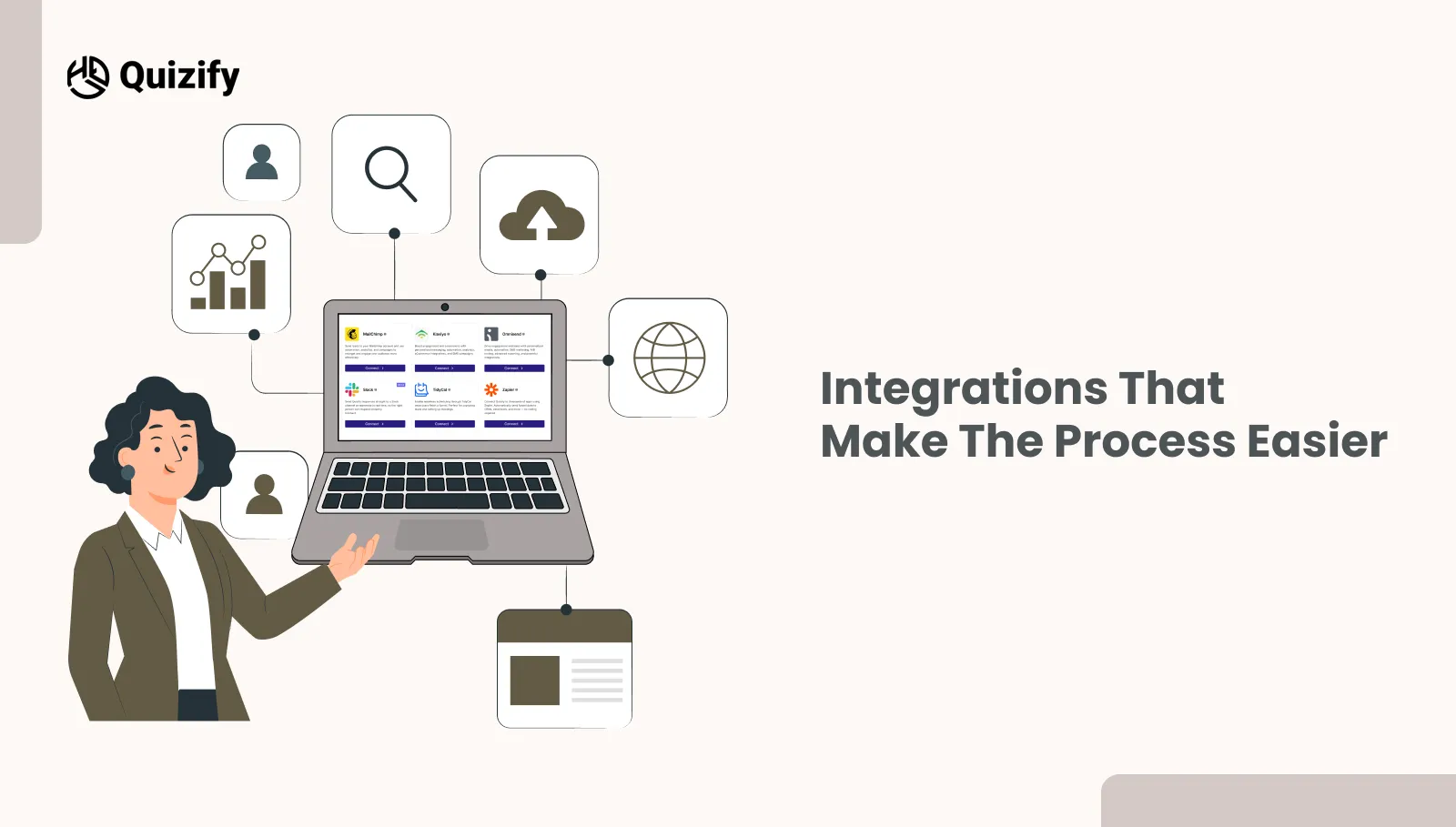
Quizify's integrations allow you to easily integrate third party tools and it can making possible to automate all processes rather than having to enter data manually into a system.
For example, you can use one of the integrations to send emails directly from your test and they will automatically be sent through your preferred email marketing system.
Similarly, when someone fills out their responses to your test, you can automatically save that data in a Google Sheet or in your CRM (Customer Relationship Management) to manage the lead tracking process.
Analytics systems, including Google Analytics, allow you to track how users respond to your test and where they drop off in the process. This information is invaluable because it allows you to continuously improve the test over time.
Integrations are helpful in many different ways, depending on what you want to accomplish from each integration:
Integration Type Example Use
Email Marketing Follow Up Emails
CRM Lead Management
Analytics Test Performance
Automation Trigger Events
The combination of these integrations increases the power and scalability of personality testing.
Basic Structure of a Personality Test
A well-designed personality test follows a simple structure, where each part has a clear role.
Here’s how the structure looks:
Section | Role |
Introduction | Sets expectations |
Questions | Collect responses |
Logic | Controls flow |
Results | Shows outcome |
Lead Capture | Collects data |
Keeping the structure simple makes the test or quiz easier to build and easier for users to complete.
Steps to Create a Personality Test
To create an effective personality test, follow the proper steps. First, determine the goal. A clear goal helps decide what type of questions to include in the questionnaire.
Next, choose one or two main themes to focus on (in this example, we will use behavior). This keeps the questionnaire focused.
When writing questions, keep them clear and concise. Complex wording creates confusion and leads participants to misunderstand how to answer. Using logic conditional statements in each question ensures the answers flow smoothly and make sense together.
An example of a simple step-by-step flow to create a personality test:
Define the goal
Choose a theme
Write the questions
Add logic
Prepare the results
TEST IT OUT
By following these steps, anyone can create a well-organized and effective personality test.
Tips to Make Your Test More Engaging
To improve your personality test, focus on user experience. Keep the quiz short so users do not feel overwhelmed. A shorter quiz usually has a higher completion rate.
Use simple and natural language. Avoid technical terms that may confuse users. The quiz should feel like a conversation.
Make sure the result provides value. Users are mainly interested in what they get at the end.
Some practical improvements include:
Keep 8–12 questions
Use simple language
Focus on results
Review and improve regularly
These small changes can make a big difference in how users interact with your quiz.
Personality Tests vs Traditional Forms
Personality tests and traditional forms offer very different user experiences. One feels interactive, while the other feels static. This difference directly affects how users respond to them.
Feature | Personality Test | Traditional Form |
Experience | Interactive | Static |
Engagement | High | Low |
Completion Rate | Higher | Lower |
Data Quality | Better | Basic |
Because of this difference, users are more likely to complete tests compared to long traditional forms. This also leads to better engagement and more useful data.
Final Thoughts
The aim of a good personality test is to be user-friendly and to allow the user to spend little time on it. Therefore the objective is to create a useful product that gathers information about users at the same time creating value for both the user and the business.
A tool such as Quizify can assist in establishing your tests and in keeping track of the results with its built-in logic, integrations, and analytical tools.
Focusing on clear and meaningful information will ensure your personality test or quiz is more attractive and will yield better results.
Similar Topic
Free Customer Feedback Survey Template
Getting started does not have to be complicated.Quizify includes a ready-to-use customer feedback survey template so you do not have to build one from scratch. It is designed to:


FAQ
Frequently Asked Questions
How many questions should a personality test have?
A personality test should have around 8–12 questions to maintain engagement and improve completion rates.
Can personality tests help in lead generation?
Yes, personality tests are effective for lead generation because they are interactive and engaging.
What improves the accuracy of a personality test?
Clear questions, structured flow, and meaningful results improve accuracy.
Can I create a personality test without coding?
Yes, Quizify allow you to build personality test without technical skills.
Why do users not complete personality tests?
Users usually leave when the test is too long, unclear, or does not provide value.