NPS vs CSAT vs CES: Which Customer Metric Should You Use?
Engagement Strategies
18 Min Read
Learn the key differences between NPS, CSAT, and CES with real examples and a clear guide on when to use each metric to improve customer experience in 2026.
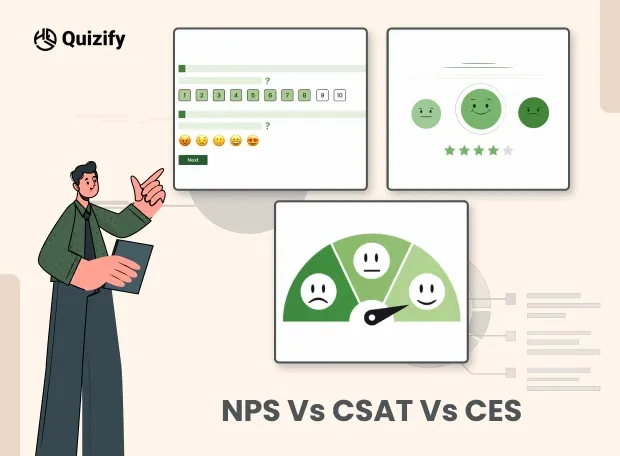
If you're trying to improve customer experience, one question always comes up:
Which survey should you use NPS, CSAT, or CES?
Most businesses use them incorrectly. The result? Misleading data, poor decisions, and missed growth opportunities.
This guide breaks it down clearly with real examples, industry benchmarks, use cases, and expert strategies, so you can choose the right metric at the right time, and use all three together for maximum impact.
NPS vs CSAT vs CES (Quick Summary)
If you want a fast answer:
NPS (Net Promoter Score) → Measures customer loyalty
CSAT (Customer Satisfaction Score) → Measures customer satisfaction
CES (Customer Effort Score) → Measures ease of experience
Simple rule:
Want to know if customers love you? → Use NPS
Want to know if they're happy right now? → Use CSAT
Want to reduce friction? → Use CES
But here's the truth most guides won't tell you: relying on just one metric will give you a dangerously incomplete picture. The companies with the highest retention rates use all three, strategically, at the right moments in the customer journey.
What Are Customer Experience (CX) Metrics and Why Do They Matter?
Customer experience metrics are quantitative tools used to measure how customers perceive and interact with your product or service at different stages of their journey.
Done right, they help you:
Reduce churn before it happens
Improve onboarding and activation
Increase retention, referrals, and revenue
Prioritize product roadmap decisions with real data
Build a customer-centric culture with shared language
Done wrong or with the wrong metric at the wrong time, they give you false confidence. A company can have a 90% CSAT score and still lose customers at scale. A strong NPS doesn't mean your onboarding works.
The core problem is that most teams treat these surveys as interchangeable. They're not. Each one measures a fundamentally different thing, at a different moment, for a different purpose.
Let's break each one down properly.
What Is Net Promoter Score (NPS)?
Net Promoter Score (NPS) was created by Fred Reichheld of Bain & Company in 2003 and published in the Harvard Business Review. It has since become one of the most widely used business metrics in the world used by companies like Apple, Amazon, Tesla, and thousands of SaaS companies.
At its core, NPS answers one question: Do customers love your brand enough to stake their reputation on recommending it?
NPS Survey Question Example
"On a scale of 0 to 10, how likely are you to recommend [Company/Product] to a friend or colleague?"
An optional follow-up open-text question:
"What is the main reason for your score?"
This follow-up is critical, it turns a number into actionable insight.
How NPS Is Calculated?
Respondents are divided into three groups:
Group | Score | Description |
Promoters | 9–10 | Loyal enthusiasts who will recommend you actively |
Passives | 7–8 | Satisfied but unenthusiastic — vulnerable to competitors |
Detractors | 0–6 | Unhappy customers who can damage your brand through word of mouth |
Formula:
NPS = % of Promoters − % of Detractors
Example: If 60% of respondents are Promoters and 15% are Detractors, your NPS = 45.
Note: Passives are excluded from the calculation, but they shouldn't be ignored, they're your biggest conversion opportunity.
What Is a Good NPS Score? (Industry Benchmarks 2026)
NPS scores vary significantly by industry. Here are current benchmarks:
Industry | Average NPS | Good NPS |
SaaS / Software | 30–40 | 50+ |
E-commerce | 45–55 | 60+ |
Financial Services | 30–40 | 50+ |
Healthcare | 25–35 | 45+ |
Telecom | 15–25 | 35+ |
Hospitality | 55–65 | 70+ |
General benchmarks:
0–30 → Good
30–50 → Great
50–70 → Excellent
70+ → World class (Apple, Chewy, and Costco consistently hit this range)
Important context: A negative NPS (below 0) means you have more Detractors than Promoters, a serious red flag for churn and reputation risk.
Two Types of NPS You Should Know
1. Relational NPS: Sent periodically (every 3–6 months) to measure overall brand loyalty. This is the standard NPS survey. It gives you a baseline view of how your brand is perceived over time.
2. Transactional NPS: Sent after a specific interaction, a purchase, a support call, a product milestone. It gives you loyalty signal tied to a specific moment. This is increasingly popular in SaaS because it connects sentiment to product behavior.
When to Use NPS?
Best timing:
Every 3–6 months as a relationship pulse check
After major product launches or updates
After pricing changes
During renewal cycles (for subscription businesses)
After completing onboarding
Best for:
Measuring brand perception and loyalty
Benchmarking against competitors or industry averages
Identifying promoters to fuel referral programs
Identifying detractors for proactive churn prevention
Real-World NPS Example
A B2B SaaS company sends an NPS survey to all users who have been active for 90 days. They find an NPS of 28 decent, but below their 40-target. By analyzing open-text responses, they discover that Detractors consistently mention "difficult reporting features." This becomes the #1 priority in their next sprint. Three months later, NPS jumps to 41.
What NPS Cannot Tell You?
NPS is a lagging indicator. It tells you how customers feel about the overall relationship, but it won't tell you why someone churned last week or where your product is losing users today. For that, you need CSAT and CES.
What Is Customer Satisfaction Score (CSAT)?
Customer Satisfaction Score (CSAT) is the most straightforward of the three metrics. It measures how satisfied a customer was with a specific, recent interaction, a support ticket, a purchase, an onboarding session, a demo call.
Think of CSAT as a real-time temperature check on individual moments in your customer journey.
CSAT Survey Question Example
"How satisfied were you with your experience today?"
Scale options (either works, consistency is key):
1–5 (1 = Very Dissatisfied, 5 = Very Satisfied)
1–10
Emoji scales (😠 → 😐 → 😊)
Optional follow-up:
"What could we have done better?"
How CSAT Is Calculated?
Only the top scores count as "satisfied":
CSAT (%) = (Number of Satisfied Responses / Total Responses) × 100
On a 1–5 scale, scores of 4 and 5 are considered satisfied. On a 1–10 scale, scores of 8, 9, and 10 are typically counted.
Example: 120 out of 150 respondents gave a 4 or 5. CSAT = (120/150) × 100 = 80%
What Is a Good CSAT Score? (Industry Benchmarks 2026)
Industry | Average CSAT | Target |
SaaS / Software | 75–80% | 85%+ |
E-commerce | 78–85% | 88%+ |
Financial Services | 72–78% | 82%+ |
Healthcare | 77–82% | 88%+ |
Retail | 74–80% | 85%+ |
Telecom | 65–72% | 78%+ |
General benchmarks:
70–80% → Average
80–90% → Good
90%+ → Excellent
When to Use CSAT?
CSAT is uniquely suited for touchpoint-level feedback, moments where something just happened and the customer has a fresh, specific reaction.
Use CSAT after:
A customer support interaction (chat, email, phone)
A product purchase or transaction
Completing an onboarding step or tutorial
A demo, training, or webinar
A product return or refund process
A billing or account change
Best timing: Immediately after the interaction, within minutes if possible. The longer you wait, the less accurate the response.
Real-World CSAT Example
An e-commerce company tracks CSAT after every delivery. They notice CSAT drops from 87% to 71% during a two-week period in December. Digging in, they find it correlates with a specific carrier's late deliveries. They proactively notify affected customers and offer a coupon, recovering 60% of at-risk purchasers before they leave a negative review.
What CSAT Cannot Tell You?
CSAT is moment-based, it doesn't predict loyalty. A customer can give a support agent a 5/5 and still cancel their subscription the next day because the product itself doesn't meet their needs.
Also, CSAT tends to skew positive, customers with neutral experiences often don't respond, so you may be measuring only your happiest and unhappiest users. Always interpret CSAT alongside response rate data.
What Is Customer Effort Score (CES)?
Customer Effort Score (CES) is the newest of the three metrics, it was first introduced by the Corporate Executive Board (now Gartner) in a landmark 2010 Harvard Business Review article titled "Stop Trying to Delight Your Customers."
The finding was counterintuitive and groundbreaking:
Reducing customer effort drives loyalty more than delighting them.
Customers don't want to be wowed. They want their problems solved quickly, without friction. CES measures exactly that, how easy or difficult it was for a customer to accomplish something.
CES Survey Question Example
"How easy was it to resolve your issue today?"
Or for product/task contexts:
"The company made it easy for me to handle my issue."
Scale: 1–7 (1 = Strongly Disagree → 7 = Strongly Agree) Or: Very Difficult → Very Easy (5-point scale)
How CES Is Calculated?
CES = Average of all effort scores
Higher scores = lower effort = better experience.
Example: If 200 responses average a score of 5.6 out of 7, your CES = 5.6.
Some companies report CES as a percentage of "low effort" responses (those scoring 5, 6, or 7 on a 7-point scale).
What Is a Good CES Score?
On a 7-point scale:
5.5–6.0 → Good
6.0–6.5 → Great
6.5+ → Excellent
The original Gartner research found that 96% of customers who reported high effort became more disloyal, while customers who reported low effort were 4x more likely to repurchase and 5x less likely to churn.
When to Use CES?
CES shines in task-completion and support contexts, wherever friction could derail an experience.
Use CES after:
A customer support interaction (especially self-service)
Completing account setup or onboarding
Using a new feature for the first time
A checkout or payment process
A product return or cancellation flow
Completing any multi-step process
Real-World CES Example
A SaaS company notices their CSAT for support is a strong 84%, but churn is still elevated. They add a CES question after support interactions and find an average score of 4.1/7, indicating high effort. Users report having to contact support multiple times for the same issue. The company adds a knowledge base and improves their first-contact resolution process. CES rises to 5.8 and 30-day churn drops by 18%.
This is the most important lesson CES teaches: satisfaction and ease are not the same thing.
What CES Cannot Tell You?
CES is task-specific. It can't tell you how a customer feels about your brand overall, or whether they'll recommend you to others. It also doesn't capture emotional connection, a customer can complete a task easily and still feel indifferent toward your brand.
NPS vs CSAT vs CES: Full Comparison
Feature | NPS | CSAT | CES |
What it measures | Brand loyalty | Interaction satisfaction | Ease of experience |
Time horizon | Long-term | Short-term | Immediate |
Best for | Growth & retention strategy | Touchpoint optimization | UX & friction reduction |
Survey timing | Every 3–6 months | Right after interaction | Right after task |
Predicts churn? | Partially | Weakly | Strongly (in SaaS) |
Predicts referrals? | Yes | No | No |
Scale | 0–10 | 1–5 or 1–10 | 1–5 or 1–7 |
Origin | Bain & Company (2003) | Industry standard | Gartner / CEB (2010) |
Industry use | Universal | Universal | SaaS, support, UX |
When NOT to Use Each Metric
This is where most companies go wrong.
Don't Use NPS:
❌ Immediately after a support chat (too broad, context is lost)
❌ To measure satisfaction with a specific feature
❌ To evaluate individual support agents
❌ As your only metric for churn prediction
Why: NPS is a relationship metric. Asking it in a transactional moment gives you noisy, misleading data.
Don't Use CSAT:
❌ To measure long-term loyalty
❌ To predict renewals or referrals
❌ As the only metric for product health
❌ More than 48 hours after an interaction
Why: CSAT is moment-based. It captures how a customer feels right now, not how they feel about the overall relationship.
Don't Use CES:
❌ To measure brand perception
❌ For marketing or brand strategy insights
❌ To evaluate overall product satisfaction
❌ After passive, low-stakes interactions
Why: CES is task-specific. Asking "how easy was it?" when nothing hard happened produces useless data.
Survey Timing Framework: When to Send Each Survey?
Use this framework to map the right metric to the right moment in your customer journey:
Customer Journey Stage | Recommended Metric | Timing |
After first support interaction | CES + CSAT | Within 1 hour |
After completing onboarding | CES | Same day |
After first purchase | CSAT | Within 24 hours |
After 30 days of product use | NPS (Transactional) | Day 30 |
After a product update | CSAT | Within 1 week |
Quarterly relationship check | NPS (Relational) | Every 90 days |
After renewal or upsell | NPS | Within 3 days |
After a refund or cancellation | CSAT | Immediately |
Ready-to-Use Survey Questions (Copy & Paste)
NPS Questions
"On a scale of 0–10, how likely are you to recommend [Product] to a friend or colleague?"
"What is the main reason for your score?"
"What would it take to improve your score?" (for Detractors and Passives)
"Is there anything specific that made you choose [score]?"
CSAT Questions
"How satisfied were you with your experience today?" (1–5)
"How would you rate the support you received?" (1–5)
"Did we resolve your issue to your satisfaction?" (Yes / No / Partially)
"What could we have done better?" (open text)
"How would you describe your experience in one word?" (open text)
CES Questions
"How easy was it to resolve your issue today?" (1–7)
"[Company] made it easy for me to get help." (Strongly Disagree → Strongly Agree)
"How much effort did you have to put in to get your issue handled?" (Very Low → Very High)
"What made this harder than it needed to be?" (open text)
Common Mistakes to Avoid
1. Survey fatigue: Sending all three surveys to the same customer in the same week destroys response rates and frustrates users. Stagger your surveys and set suppression rules (e.g., no customer receives more than one survey per 30 days).
2. Asking at the wrong time: NPS sent right after a bad support interaction will tank your score for the wrong reasons. CSAT sent 2 weeks after a purchase is useless. Timing is everything.
3. Ignoring qualitative responses: The open-text follow-up is often more valuable than the score itself. Use text analysis tools (or AI) to tag and categorize themes from qualitative responses at scale.
4. Not closing the feedback loop: When a customer gives you a 3/10 NPS or a 1/5 CSAT, they expect something to happen. Automated follow-ups for low scores (called "closed-loop feedback") are one of the highest-ROI activities in CX programs. Customers who receive a response to negative feedback are more likely to stay than those who don't.
5. Benchmarking yourself against the wrong industry: A 35 NPS looks great for telecom but weak for hospitality. Always benchmark against your specific industry, not generic averages.
6. Using vanity metrics without action: Collecting feedback without acting on it actively reduces customer trust. Customers know when surveys go nowhere.
Advanced Strategy: How to Use All Three Together
High-performing customer experience teams don't choose one metric, they build a layered CX measurement system using all three.
Here's what a complete, best-in-class system looks like:
Step 1: Map Your Customer Journey
Identify every major touchpoint a customer has with your business from first touch to renewal. This typically includes:
First contact / lead capture
Trial or onboarding
First value moment ("aha moment")
Support interactions
Billing and renewals
Product milestones
Offboarding / cancellation
Step 2: Assign the Right Metric to Each Touchpoint
Support interactions → CES (was it easy?) + CSAT (were they happy?)
Onboarding steps → CES (was setup easy?) + NPS at day 30 (do they love it?)
Quarterly check-ins → Relational NPS
Feature launches → CSAT
Renewals → Transactional NPS
Step 3: Build a Closed-Loop Feedback Process
Define who owns follow-up for each score threshold:
NPS 0–6 (Detractor) → Customer Success reaches out within 24 hours
CSAT 1–2 → Support lead reviews and contacts customer
CES 1–3 → Product team flagged for UX review
Step 4: Share Data Across Teams
CX metrics should not live in a single dashboard owned by one team. The best companies share:
NPS data with Marketing and Product
CSAT data with Support and Operations
CES data with Product and Engineering
Step 5: Review and Act Monthly
Set a monthly CX review meeting where all three metrics are reviewed together. Look for correlations:
Is CES low in a specific flow where NPS is also declining?
Is CSAT high but NPS flat? (A sign customers are happy with support but indifferent to the product)
Is NPS rising while CES is falling? (A warning sign, loyalty may erode soon)
Choosing the Right Survey Tool
Here are tools purpose-built for each metric:
Tool | Best For | Pricing |
Quizify | CSAT, CES and NPS(Coming soon) | Free plan available |
Delighted | NPS, CSAT, CES (all three) | Free plan available |
Typeform | CSAT, custom surveys | From $25/month |
SurveyMonkey | All metrics, enterprise | Free plan + paid tiers |
Hotjar | In-product CSAT & CES | Free plan available |
Medallia | Enterprise NPS & VoC | Custom pricing |
AskNicely | NPS for SaaS | Custom pricing |
Qualtrics | Enterprise CX programs | Custom pricing |
FAQs
What is the difference between NPS, CSAT, and CES?
NPS measures long-term loyalty by asking if customers would recommend you. CSAT measures satisfaction with a specific recent interaction. CES measures how easy it was to complete a task or resolve an issue. Each captures a different dimension of the customer experience.
Which is better: NPS or CSAT?
Neither is universally better, they measure different things. NPS is better for understanding long-term loyalty and growth potential. CSAT is better for evaluating specific touchpoints and interactions in real time. Most companies need both.
Which metric best predicts churn?
In SaaS and subscription businesses, CES is often the strongest predictor of early-stage churn. If users struggle during onboarding, they leave, even if they're technically "satisfied." NPS is the best predictor of long-term churn and referral behavior.
What is a good CES score?
On a 7-point scale, a CES of 5.5 or higher is considered good. Above 6.0 is great. The goal is always to make experiences as frictionless as possible. Even small improvements in CES correlate with meaningful reductions in churn.
Can I use NPS, CSAT, and CES together?
Yes, and you should. Using all three provides a complete, layered view of your customer experience. NPS tells you the "what" (loyalty), CSAT tells you the "when" (which moments matter), and CES tells you the "why" (where friction is hurting you).
How often should I send NPS surveys?
Relational NPS should be sent every 3–6 months. Transactional NPS can be sent after key milestones (day 30, post-renewal, post-onboarding). Avoid sending NPS more than once per quarter to the same customer to prevent survey fatigue.
What response rate should I expect?
Average response rates: Email NPS surveys: 20–30%. In-app NPS: 40–60%. CSAT (post-support): 15–25%. CES (post-support): 15–25%. In-app surveys generally outperform email by 2–3x.
How do I increase survey response rates?
Send in-app rather than email where possible
Keep surveys to 1–2 questions maximum
Personalize the survey with the customer's name and context
Send within minutes of the interaction, not days later
Use conversational language, not corporate language
Final Thoughts
If you rely on just one metric, you're only seeing a fraction of the picture and making decisions with incomplete data.
NPS tells you who loves your brand and whether you'll grow
CSAT tells you how customers feel about specific moments
CES tells you where friction is silently costing you customers
The real competitive advantage comes when you combine all three strategically, mapping each metric to the right moment, building closed-loop processes to act on the data, and sharing insights across your entire organization.
Customer experience isn't a single number. It's a system. And now you have the tools to build it properly.
Join our newsletter list
Sign up to get the most recent blog articles in your email every week.
Similar Topic