Why Your Discovery Calls Go Nowhere: How to Qualify Leads Before They Book
Marketing and Promotion
12 Min Read
Use smart lead qualification questions to understand prospects, filter out poor-fit leads, and improve your sales process.
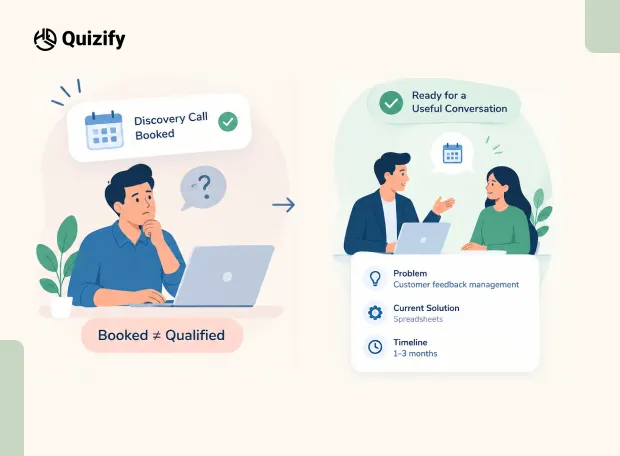
Getting a discovery call booked feels like progress, but a booked meeting does not always mean you have a qualified lead.
The call can quickly go nowhere when the lead is just exploring, does not have a clear problem, or is not ready to make a change.
The solution is not to ask 20 questions before they can book. You just need to know a few things first: what problem they have, how important it is, what they use now, and when they want to act.
In this guide, we’ll look at how to qualify leads before a discovery call and how a simple quiz can help.
Why Discovery Calls Fail Before They Start
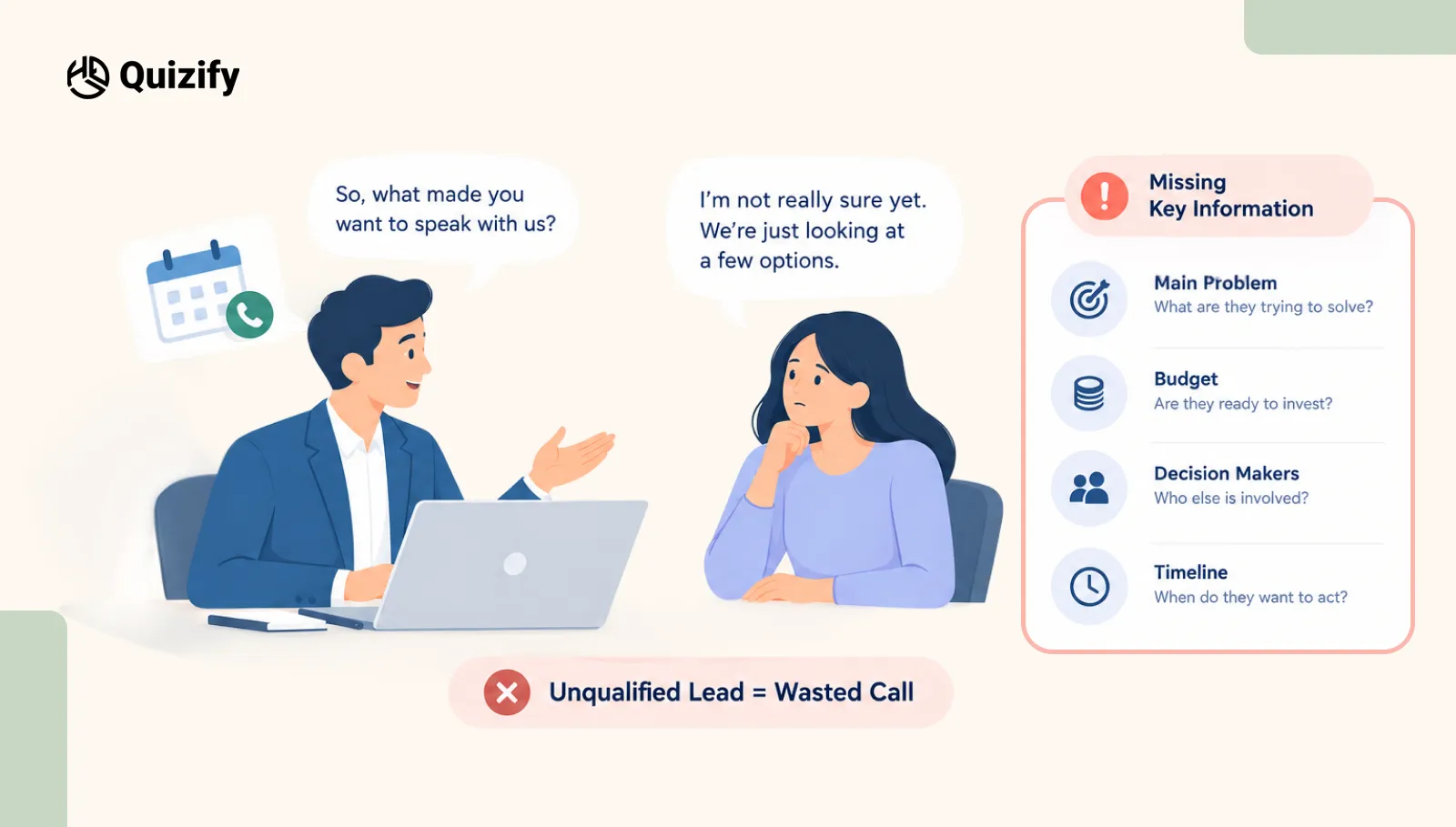
A discovery call is supposed to help you understand the lead, their problem, and whether there is a good reason to keep talking.
But that becomes difficult when the sales person spends the first half of the call trying to figure out why the lead booked in the first place.
The conversation may sound something like this:
Sales person: “So, what made you want to speak with us?”
Lead: “I’m not really sure yet. We’re just looking at a few options.”
Sales person: “Okay. What are you currently using?”
Lead: “Nothing at the moment.”
Sales person: “And when are you hoping to make a decision?”
Lead: “We haven’t really decided.”
There is nothing wrong with asking these questions. In fact, they are part of a good discovery conversation.
The problem is when every important piece of information has to be uncovered from scratch during the call.
Sales qualification is about determining whether a lead is a good fit for what you offer. Common qualification areas include need, budget, decision-making involvement, and timing.
You do not need to answer all of those questions before someone can speak with sales. But you should know enough to decide whether the meeting is worth having and how the salesperson should approach it.
The problem starts before the booking
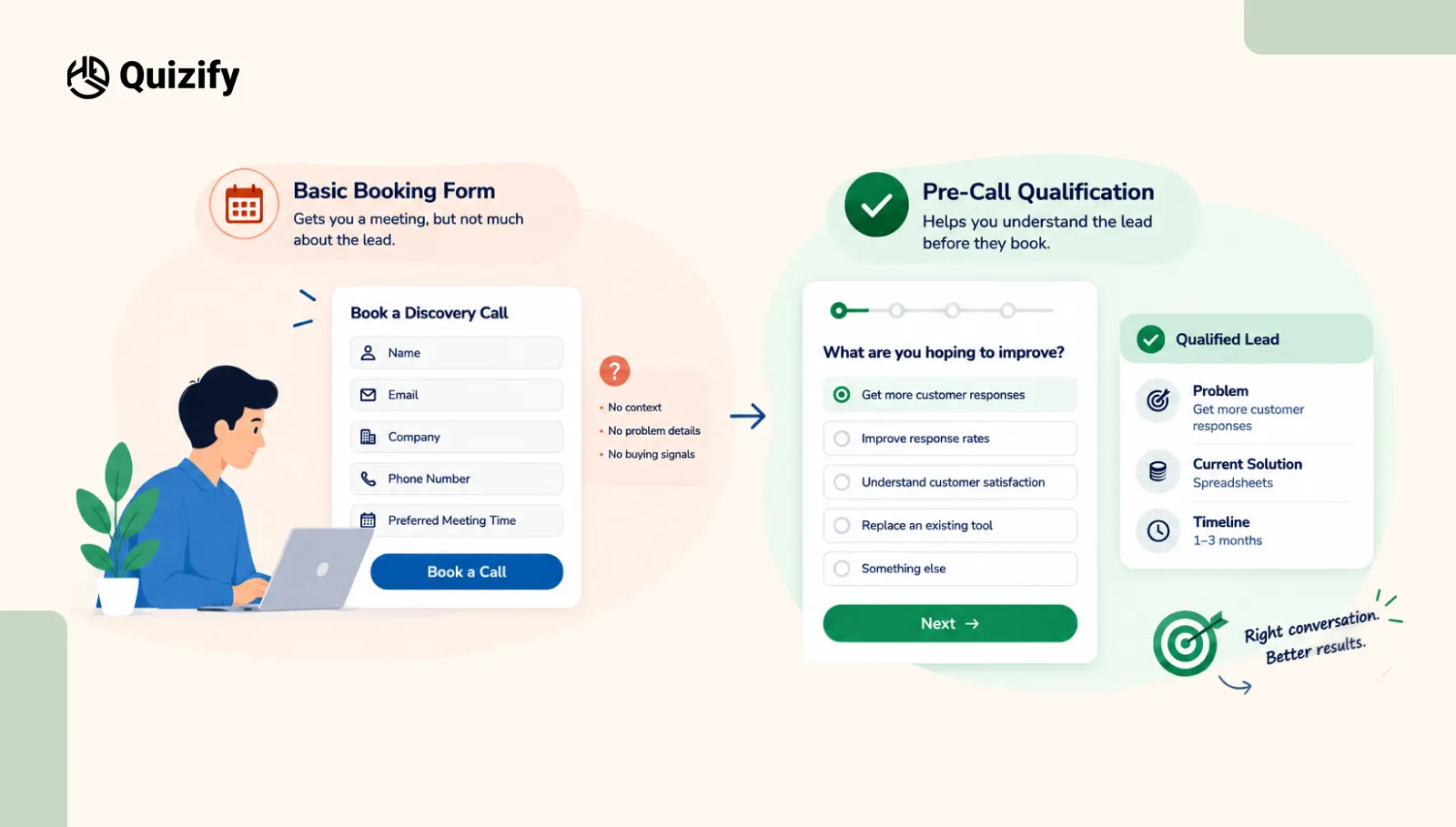
If your calendar is full but your sales team keeps having calls with people who are not ready to buy, the problem may be how you qualify leads before they book.
A simple booking form often asks for:
Name
Email
Company
Phone number
Preferred meeting time
That information helps you schedule the meeting, but it does not show you much about why the person wants to talk.
Compare that with a prospect who says:
“We currently use spreadsheets to manage customer feedback. As we get more responses, the process is becoming difficult to manage. The plan is to replace it within the next three months.”
Now the sales person has something to work with before the call even begins. They know the current situation, the problem, and the rough timeline. That is the difference pre-call qualification can make.
What should you know before a customer books a call?
You do not need to collect every detail about a customer. Start with the information your sales team would actually use during the conversation.
Here are the main areas worth considering:
What to qualify | Why it matters |
Main problem | Helps you understand why the prospect is looking for a solution |
Impact of the problem | Shows whether the issue is important enough to act on |
Current solution | Gives context about what they use today |
Timeline | Helps separate active projects from casual research |
People involved | Shows who may influence or make the decision |
Commercial fit | Helps identify whether your solution is realistic for them |
You may not need all six. The right questions depend on what you sell and how your sales process works.
The problem they are trying to solve
If someone cannot explain what they are trying to improve, fix, replace, or achieve, it may be too early for a sales call.
Instead of asking:
“Are you interested in our product?”
try something more useful:
“What are you hoping to improve?”
For example, a customer feedback platform might offer:
Getting more customer responses
Improving response rates
Understanding customer satisfaction
Replacing an existing tool
Automating feedback collection
Something else
This gives the sales team a much better starting point.
How much does the problem matter?
Not every problem has the same level of urgency. Someone may know that their current process is inefficient but still be happy to live with it for another year.
Another lead may be losing customers because of the same problem and needs to fix it this quarter.
Those two leads may look identical on a basic booking form, but they need very different sales conversations.
A simple question can help:
“How is this problem affecting your business today?”
You can offer answers such as:
It's a minor inconvenience
It slowing our team down
It is costing us time or money
Affecting customers
We need to fix it soon
You are not trying to force urgency. You are trying to understand it.
How are they solving the problem now?
Knowing the current situation gives your salesperson useful context before the call.
Ask:
“How are you handling this today?”
The answer might be:
We use spreadsheets
Use another platform
Handle it manually
We have an internal system
We are not doing anything yet
This can also help you understand what the prospect may be comparing you against.
When do they want to make a change?
Timing matters, but it does not need to be complicated. Someone who wants to make a change this month is different from someone who is only looking at options for next year.
You could ask:
“When would you ideally like to have a solution in place?”
Then provide a few realistic options:
As soon as possible
Within 1–3 months
Within 3–6 months
Later this year
Just researching for now
This gives your sales team context without forcing the prospect to provide an exact date.
Who else is involved?
However, a discovery call may not lead anywhere when the person on the call is not involved in the decision.
That does not automatically make them an unqualified lead. They may be the person researching options or recommending a solution internally.
The useful question is:
“Who else will be involved in choosing a solution?”
They might say:
Just me
My manager
Our marketing team
Our operations team
A business owner or executive
We have not decided yet
That gives the salesperson a better idea of how the buying process may work.
How to build a pre-call qualification flow

Once you know what you need to learn, keep the process simple.
A good pre-call flow might look like this:
Step 1: Identify the problem
Ask what the prospect is trying to solve.
Step 2: Understand the current situation
Find out what they are doing today.
Step 3: Understand the impact
Ask what the problem is costing them in time, money, customers, or effort.
Step 4: Check timing
Find out whether they are actively looking or simply researching.
Step 5: Understand the buying process
Ask who else may be involved.
Step 6: Decide what happens next
If the answers show a good fit, let them book a discovery call. If they are not ready, give them a more useful next step.
The point is not to build a wall between your marketing and sales teams. The point is to make sure the person booking the call has a reason to have it.
Why use a quiz instead of a long form?

A long qualification form can collect a lot of information, but that does not mean people will want to complete it.
This is where an interactive quiz can be useful.
Instead of presenting a prospect with a page full of empty fields, you can ask one question at a time and use their answers to determine what they see next.
For example:
What are you mainly trying to improve?
→ Lead generation
→ Customer feedback
→ Sales follow-up
→ Marketing automation
If they choose Lead generation, the next question can focus on their current lead process.
If they choose Customer feedback, you can ask about their current feedback method.
This keeps the experience relevant instead of making everyone answer the same questions.
Quizify supports logic jumps, so different answers can lead people to different questions instead of forcing every visitor through the same path.
That matters because qualification should be useful to the prospect too. If every person gets 15 questions regardless of their situation, the process starts to feel like work.
A simple pre-call qualification quiz
You do not need a huge questionnaire to get useful information. For many businesses, five to seven questions may be enough to give sales a clearer picture.
Here is one example:
Question | Example answers |
What are you trying to improve? | Lead generation / Customer experience / Sales process / Other |
How are you handling it today? | Manually / Spreadsheet / Existing tool / Nothing yet |
What is the biggest challenge? | Time / Cost / Results / Scale / Other |
How important is fixing it? | Low / Medium / High |
When would you like to make a change? | Now / 1–3 months / 3–6 months / Researching |
Who is involved in the decision? | Me / Manager / Team / Executive |
What would you like to do next? | Book a call / Learn more / See pricing |
The exact questions will depend on your product. For example, a marketing agency may need to know monthly ad spend and current channels. A SaaS company may care more about team size, current software, and implementation timing.
So do not copy a qualification framework word for word. Start with what your sales team actually needs to know.
How to turn qualification answers into action

Collecting answers only helps if you use them. For example, a lead completes the quiz, but the answers just sit in a spreadsheet. Then the salesperson starts the call by asking:
“So, tell me a little about what you’re looking for.”
You already asked them that. Instead, use their answers to decide what happens next.
For example:
Lead situation | Possible next step |
Clear problem + strong urgency | Send directly to sales booking |
Clear problem + later timeline | Add to a nurture sequence |
Good fit but needs more information | Send relevant resources |
Unclear problem | Offer educational content |
Poor fit | Do not send directly to sales |
Existing customer looking for another solution | Route to the appropriate team |
The goal is not to reject people as quickly as possible. It is to give each person a next step that makes sense for where they are. Quizify can support this type of funnel with different result types, logic jumps, lead capture, analytics, and integrations.
How Quizify can help
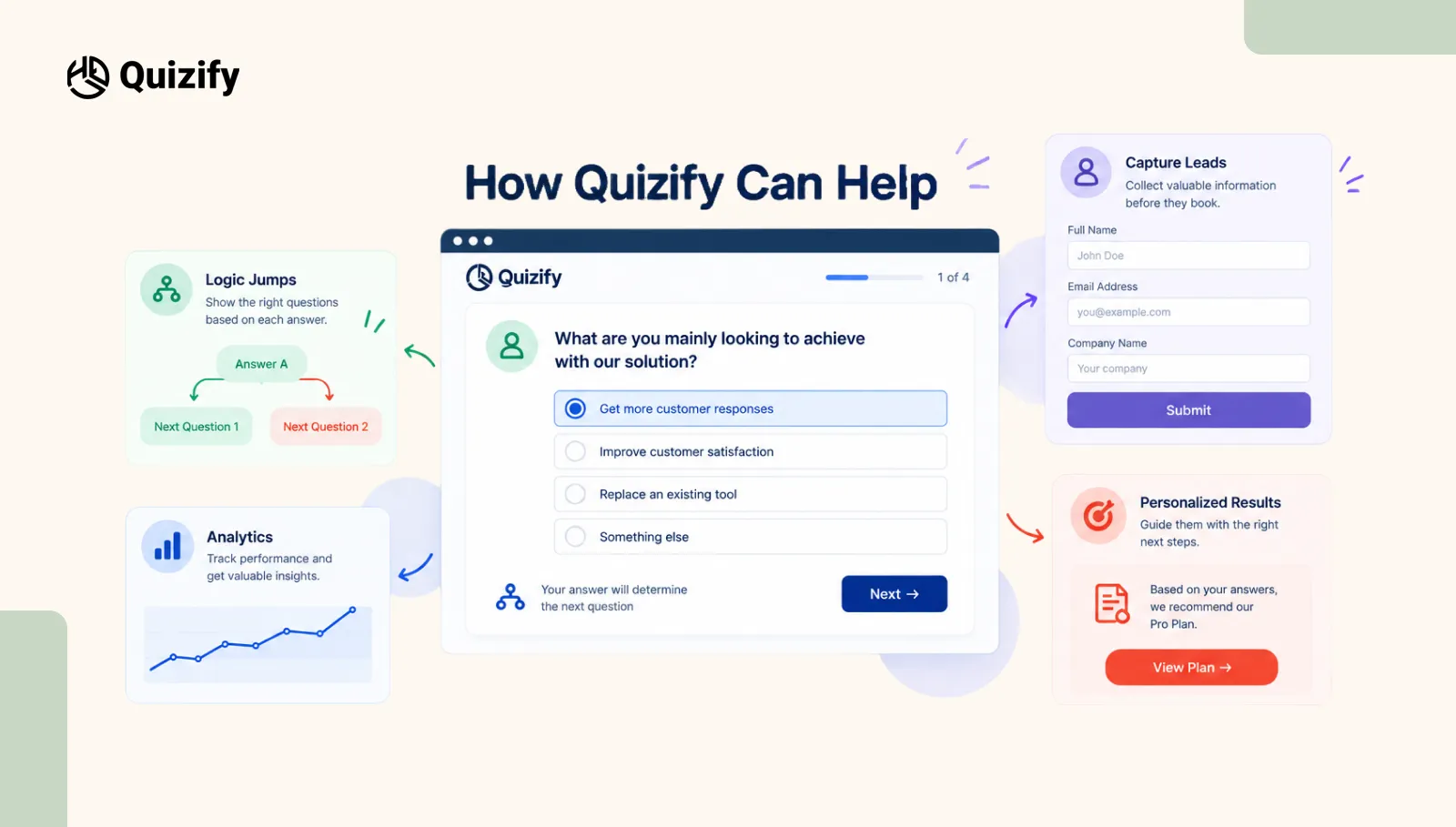
If you already know which answers indicate a sales-ready lead, you can build those criteria into your quiz.
For example, you might decide that a lead should be sent to sales when they:
Have a problem your product solves
Are actively looking for a solution
Have a reasonable timeline
Fit your target customer profile
You can then use the quiz to collect those answers before the prospect reaches the calendar.
Quizify also lets you use logic to show relevant questions based on previous answers. That means a prospect does not have to complete a long, generic questionnaire just to book a meeting.
This approach fits a broader principle in lead-generation funnels: decide what qualifies someone as sales-ready first, then collect only the information you need to make that decision.
The result should be simple:
Answer a few useful questions → understand the prospect → decide the right next step → book the call when it makes sense.
Common mistakes to avoid
Pre-call qualification can create extra work for leads if you are not careful. Here are some common mistakes to avoid:
Asking too many questions
You do not need to ask the lead everything before the call. The goal of pre-call qualification is to give the salesperson enough information to understand the situation before the conversation starts.
The discovery call is still where the salesperson should ask follow-up questions, understand the problem in more detail, and decide what to do next.
For example, you can ask a few questions about the lead’s problem, current solution, and timeline before they book. Then, during the call, the salesperson can use those answers to ask better questions instead of starting from scratch.
Gong’s analysis of more than 519,000 B2B sales calls found that 11–14 focused questions were linked to better outcomes. However, asking too many questions can make the conversation feel like an interrogation.
So, keep the pre-call questions focused. Use them to give the salesperson context, not to complete the entire discovery call before it starts.
Asking questions sales will never use
If the sales team does not look at the answer, do not ask the question.Every question should have a reason. Before adding one, ask:
“What will we do differently if we know this?”
If the answer is “nothing,” remove it.
Making every lead answer the same questions
Someone who is ready to buy and someone who is only researching do not need exactly the same experience. Use branching questions when the answer changes what you need to know.
Making budget the first filter
Budget can matter, but it is not always useful as an opening question. A prospect may not know what a realistic budget looks like because they have never bought this type of solution before.
Qualification should give you a better understanding of the problem and buying situation, not just produce a yes-or-no budget answer.
Treating qualification as rejection
A lead who is not ready today is not necessarily a bad lead. They may need more information, a different offer, or more time. If your qualification process only answers “send to sales” or “reject,” you may be throwing away useful opportunities.
Conclusion
A discovery call can only go so far if the salesperson has to figure out everything from scratch.
The better approach is to collect enough information before the meeting to understand why the prospect is interested, what problem they are dealing with, how important it is, and whether there is a realistic reason to talk now.
You do not need a complicated qualification system to do that.
Start with the questions that actually matter to your sales process. Keep the experience short. Use branching questions when different answers require different follow-ups. Then connect those answers to a clear next step.
An interactive quiz can make this easier because it lets you collect useful information without putting a long qualification form between the prospect and the next step.
And when the prospect finally joins the discovery call, your sales team should not have to start with, “So, why did you book this call?”
They should already have a good idea.
Join our newsletter list
Sign up to get the most recent blog articles in your email every week.
Similar Topic
Related Blogs



FAQ
Frequently Asked Questions
How many questions should I ask before a discovery call?
There is no fixed number that works for every business. Start with the minimum information your sales team needs to decide whether the call makes sense.
If your qualification flow is becoming long, look at each question and ask whether the answer will actually change what happens next.
Should every lead complete a qualification quiz?
Not necessarily. If your sales process is simple and most leads are already well qualified, a short form may be enough. A quiz becomes more useful when prospects have different needs, buying stages, or possible next steps.
Should I ask about the budget before booking a discovery call?
Only if budget is genuinely important to determining fit. For some businesses, a price range can quickly identify a mismatch. For others, asking about budget too early may create unnecessary friction, especially when prospects do not yet understand the value or typical cost of the solution.
What should I do with leads that are not ready for sales?
Do not automatically discard them. If they have a relevant problem but are not ready to buy, consider sending educational content, showing relevant resources, or adding them to a nurture sequence. The right next step depends on why they are not ready.
Can a quiz replace a discovery call?
No. A quiz can collect context and help qualify the lead, but it should not replace the conversation.
The discovery call is where your salesperson can ask follow-up questions, understand the situation in more detail, discuss possible solutions, and decide whether there is a good fit.