Combining Quizzes and Forms to Understand Your Customers Better
Engagement Strategies
9 Min Read
Use quizzes and forms together to uncover customer preferences, qualify leads, and create more personalized experiences.
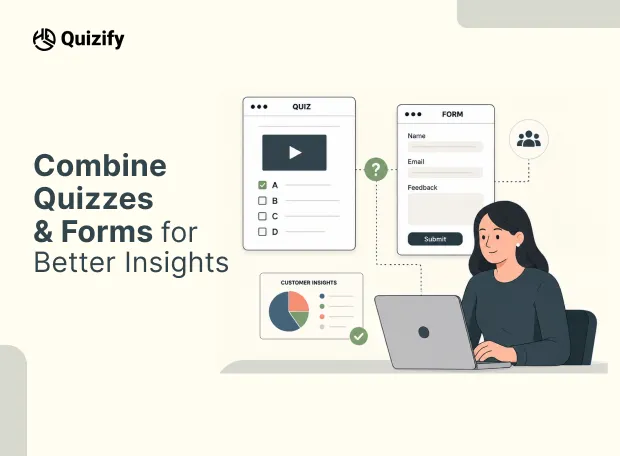
Nowadays, customer data is among the most precious assets of digital marketing. Marketers rely on it to understand customers, personalize services, and enhance their overall lead generation strategies. Collecting this type of customer information with older, traditional methods has become harder because people increasingly avoid long, boring steps in online journeys.
Most websites still use classic online forms and quizzes alone. These static questionnaires usually cannot hold people's attention for long. Users now expect faster, more interactive experiences, which has changed how brands approach customer data collection.
This shift comes down to changing user expectations. People now prefer digital experiences that feel dynamic rather than ones that feel like data entry. As a result, modern marketing is moving toward formats that guide users rather than just asking them to fill in fields.
Why Traditional Forms Are Losing Effectiveness
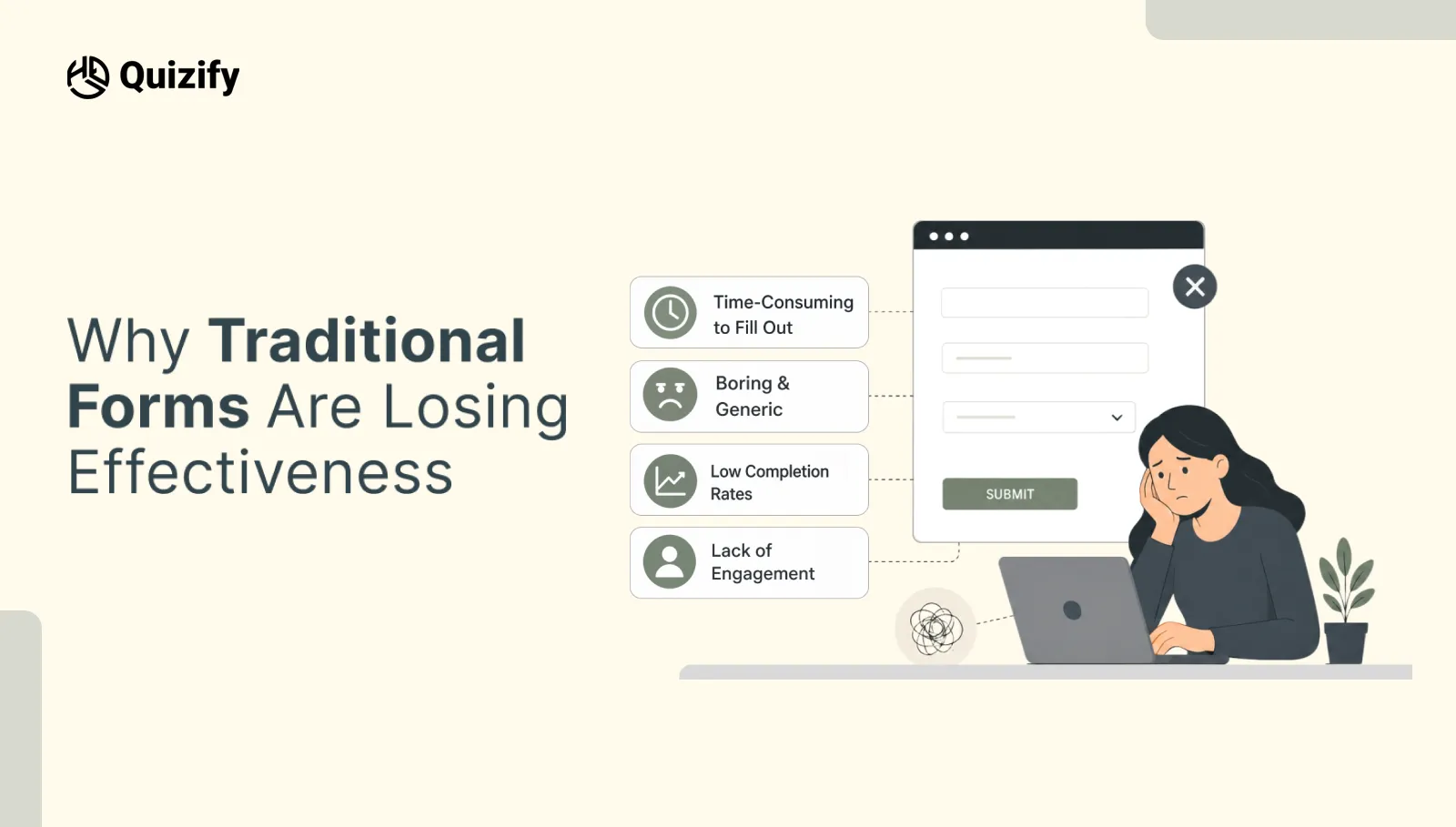
Traditional lead generation forms are the basic types of forms that are simple. Even so, they are usually less effective to use in today's digital settings.
This shift comes down to changing user expectations. People now prefer digital experiences that feel dynamic rather than ones that feel like data entry. As a result, modern marketing is moving toward formats that guide users rather than just asking them to fill in fields.
Commonly, these forms request:
Name
Email address
Phone number
Company details
Budget
While these fields are important for business qualification, presenting them all at once without context often creates friction in the user journey, reducing the likelihood of completion.
Reasons why users typically leave the form:
It is too long
There is no instant benefit
There is no interaction
It is repetitive
The result is a drop in conversion rate and poorer data quality.
At times, businesses gather the most basic information only, skipping only the valuable customer insights that matter.
How Quizzes Improve Customer Engagement
Instead of asking users to fill out a form, quizzes walk them through a set of questions one at a time. The experience feels more like a conversation than a data collection exercise.
For Example:
Offering a form is a business approach; here are some conversational options businesses can use:
"Forget the form. Take a few minutes to answer these short questions, and we’ll match you with the option that fits you best. “
This leads to better user experience optimization and an increased number of users finishing the process.
Quizzes come in several formats, each serving a different purpose depending on what a business wants to learn from its audience:
Quiz Type | Objective |
Test product recommendation | Helps customers discover the option that fits their needs and expectations most closely. |
Marketing evaluation test | Evaluates business performance |
Test Your Personality | Identifies personality traits of users |
Assessment of skills | Tests skill or knowledge level |
Customer requirement quiz | Identifies customer pain points and needs |
These formats help businesses collect better data while keeping users engaged.
Types of Data You Can Collect
Businesses that use both quizzes and forms together are able to gather richer, more detailed information from their customers.
Data Type | Example |
Customer profile data | Basic details such as age, location, and the industry they work in |
Preference data | Interests in products or services |
Behavioral data | Purchasing habits |
Pain points | Customer challenges |
Purchase readiness | Shows how close a customer is to making a decision |
Combining this data provides a stronger understanding of customers and more precise segmentation.
Rather than collecting contact details alone, businesses can use this data to build a clearer picture of what their customers actually want.
Benefits of Combining Forms and Quizzes
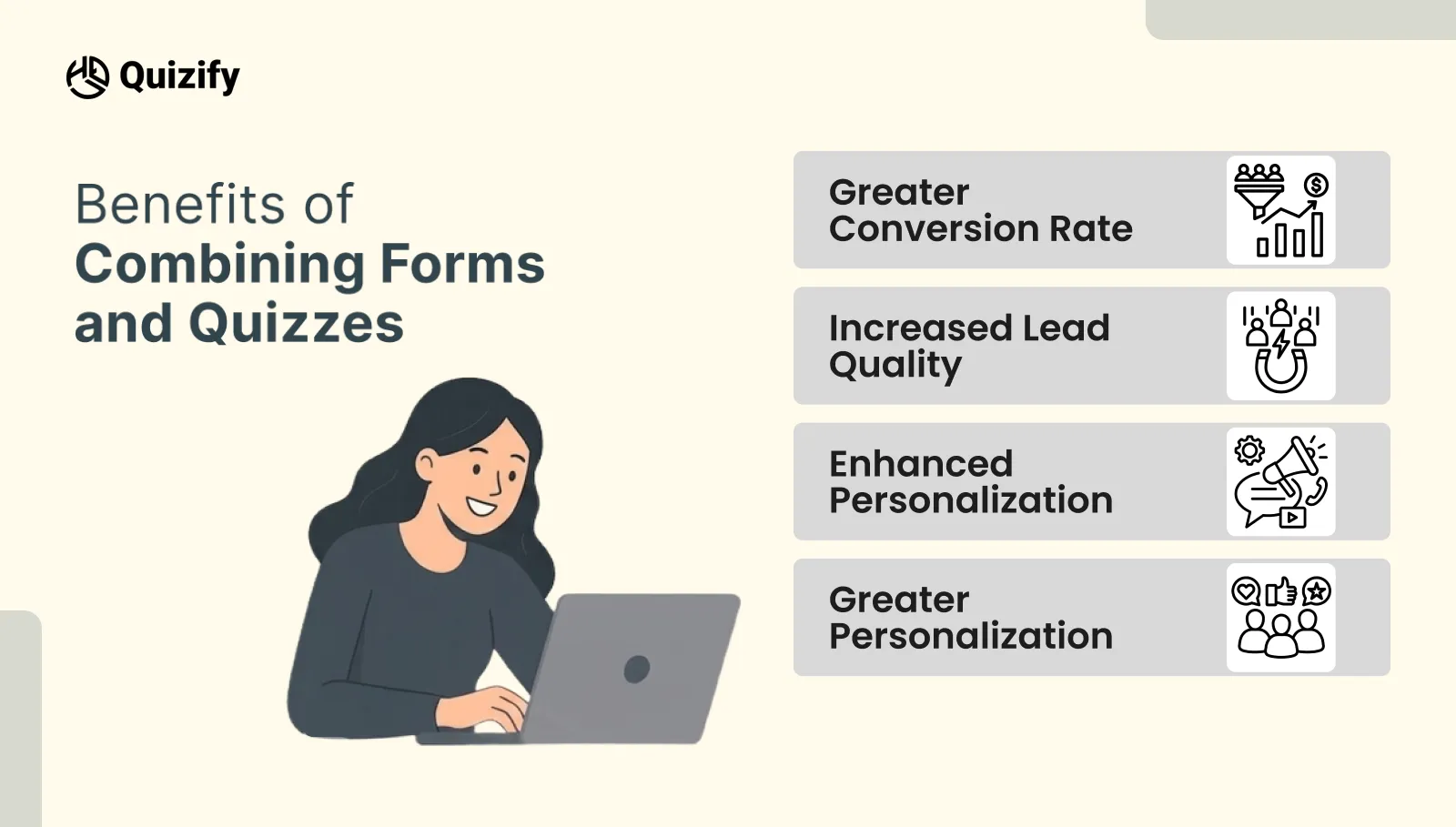
Using quizzes together with forms can strengthen several parts of a brand’s online marketing efforts, from engagement to conversions.
Greater Conversion Rate
Forms combined with quizzes create a more stimulating and engaging interactive experience that increases the likelihood of completion compared to traditional online forms.
Increased Lead Quality
The quantity of data improves the quality of leads and offers greater improvement and outcomes in the lead generation strategy.
Enhanced Personalization
Responses create an opportunity to build campaigns with greater focus on personalization.
Greater Personalization
Due to the nature of quizzes, participants engage with the medium for greater periods, creating a direct improvement in engagement metrics across the board.
Common Mistakes to Avoid
While combining quizzes and forms can help improve customer data collection, a few mistakes can make the process less effective.
Here are some things to avoid:
Making quizzes too long
Asking questions that do not really matter
Showing forms too early
Giving results that feel too general
Making the whole experience confusing
People generally have a smoother experience when interfaces remain clear, straightforward, and easy to follow.
Conclusion
Modern customer data collection is no longer about filling out long forms. It is about building interactions that are genuinely helpful, relevant, and engaging.
Traditional lead generation forms have their advantages and still carry value Still they are most efficient when paired with interactive quizzes.
If a company uses a combination of these two methods, it will be able to increase the percentage of conversions, gain deeper knowledge of the customers, and design more powerful systems for lead generation strategies.
This is not a short-term tactic. This method provides an excellent way to understand the needs and preferences of customers in our increasingly digital global marketplace.
FAQs
1. Why are quizzes becoming so popular when it comes to collecting customer data?
Quizzes are more fun than forms. They do not just ask people to fill in their details, they ask questions that make people want to share information about themselves. This is because quizzes feel more engaging than forms.
2. Do quizzes only attract attention, or do they also help improve the quality of leads?
They do both. Quizzes encourage more people to participate, and at the same time they reveal what users prefer, what they need, and how they behave, which makes each lead more valuable for both sales teams and marketing campaigns.
3. Is it still necessary to use forms if we are already using quizzes?
Yes, it is still necessary to use forms. Quizzes help us understand people better. Forms are where we collect important details like email addresses or phone numbers. Quizzes and forms work well when we use them together.
4. What kind of businesses should use quizzes and forms together?
This strategy works well for businesses that are online but it is especially good for businesses that sell things online companies that make software, agencies and businesses that provide services. For these businesses it is really important to understand what customers need.
5. What is the biggest mistake businesses make when they use quizzes?
Most businesses make their quizzes too long. They ask questions that are not relevant. If people feel like it is taking too much time or if they do not think they are getting anything out of it they will stop taking the quiz before they finish it. Businesses make this mistake when they create quizzes that're too long or ask irrelevant questions about quizzes.
Join our newsletter list
Sign up to get the most recent blog articles in your email every week.
Similar Topic