Multi-Step Forms vs. Single Page: Conversion Tips and Test Plan

Integration

Feb 17, 2026

2/17/26

8 Min Read

Multi step form or single page form. See when each layout wins, avoid common mistakes, and use a simple A/B test plan to pick the right option for your funnel.
If your signup rates are dropping or conversions feel stuck, your form layout could be the hidden reason. Choosing between a multi-step form and a single-page form directly impacts user experience, perceived effort, mobile usability, and overall conversion rates. The right structure can reduce friction, improve error handling, and increase completions — especially for mobile visitors. In this guide, we’ll compare multi-step vs. single-page forms, share practical conversion optimization tips, and outline a simple A/B test plan so you can make data-driven decisions that boost results.

An Overview of Each Layout Type

  • Multi-step form
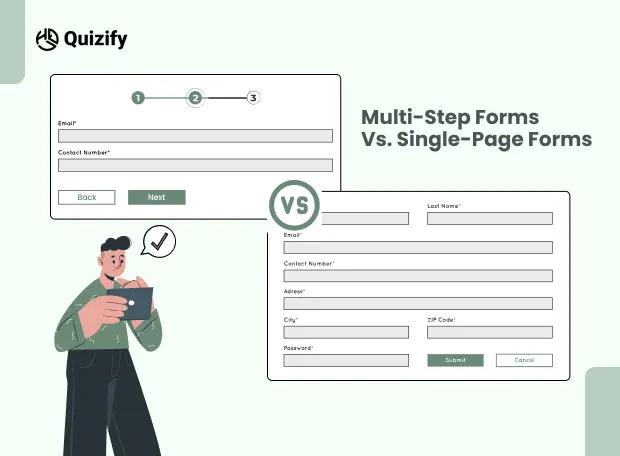
    A form split into short screens. Each step collects a small group of fields and shows progress with clear Next and Back actions.

  • Single-page form
    All required fields live on one screen. Users can scan everything at once, scroll, complete, and submit in a single move.

When a Multi-Step Form Wins
When a Multi-Step Form Wins | Quizify
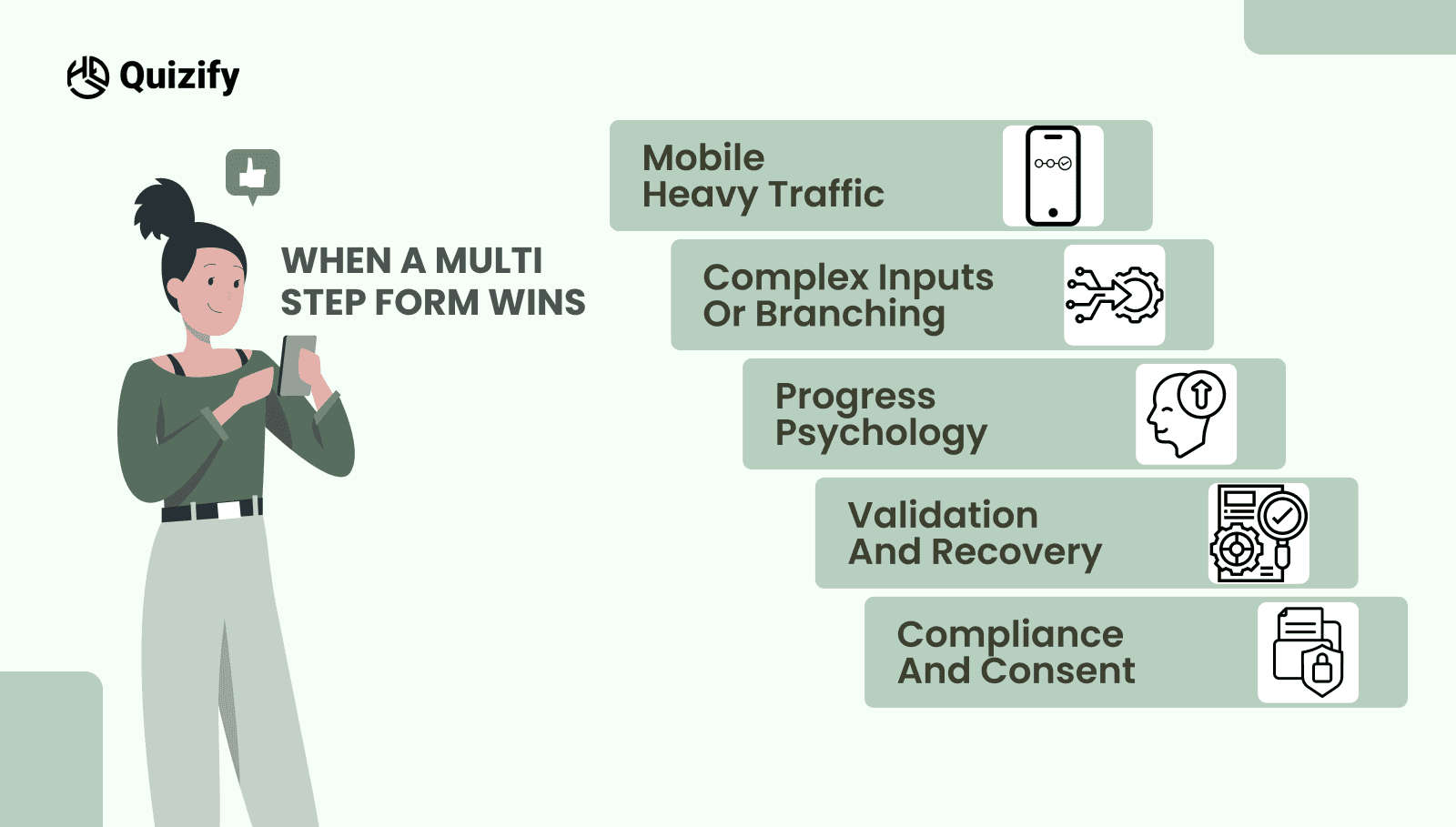
  • Mobile heavy traffic
    A multi-step form reduces perceived effort by chunking questions. A clear indicator such as Step 2 of 5 keeps people moving.

  • Complex inputs or branching
    Conditional logic, file uploads, or role-based paths are easier to understand in steps. Context stays focused, and confusion drops.

  • Progress psychology
    Small wins motivate me. Short steps with visible progress reduce mid-flow abandonment.

  • Validation and recovery
    You can validate as people go, catch errors early, and save partial progress. Losing everything at submit is less likely.

  • Compliance and consent
    If legal text needs space, a multi-step form can place it where it is relevant, not as a wall at the end.

When a Single-Page Form Wins
When a Single-Page Form Wins | Quizify
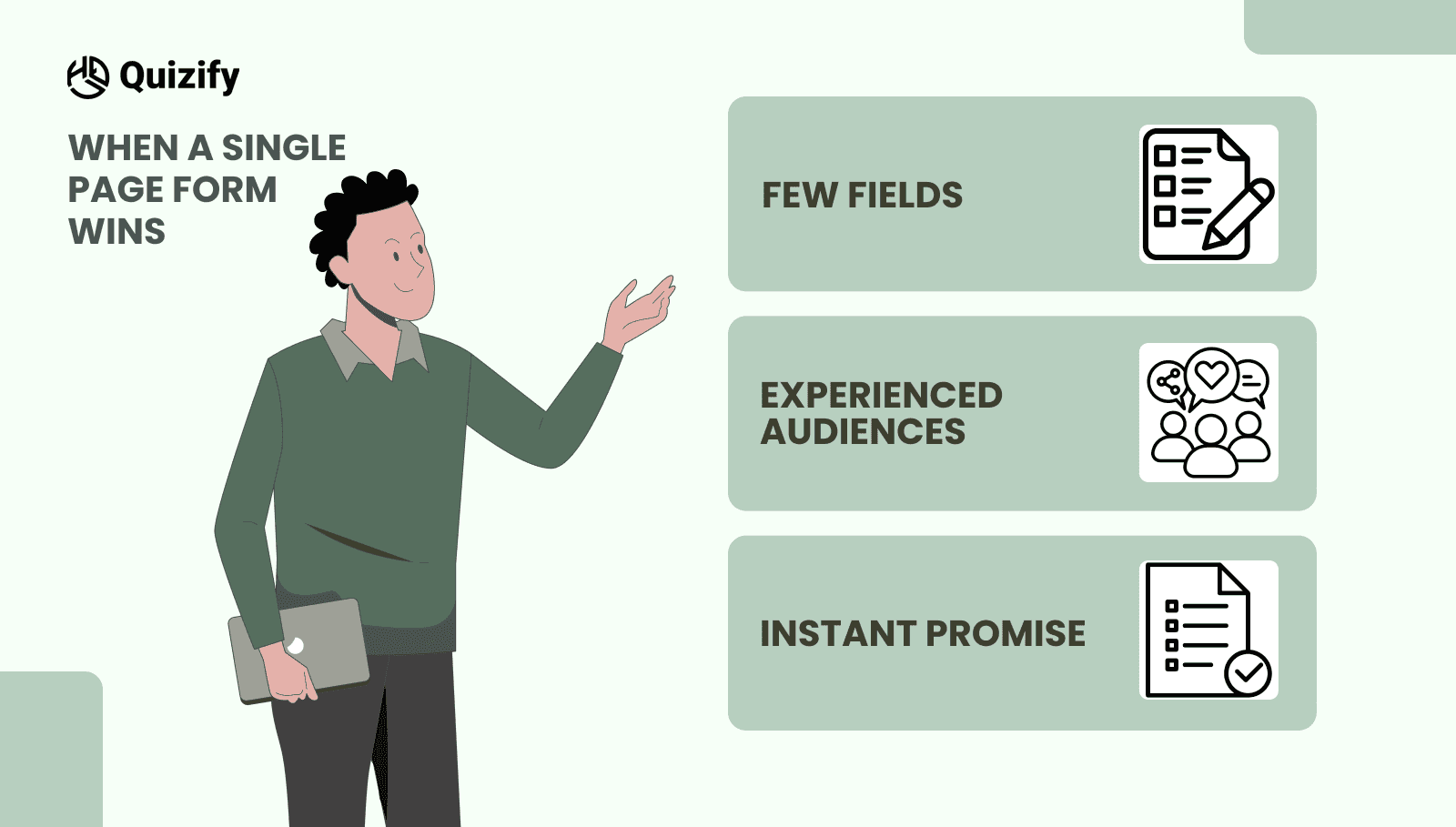
  • Very few fields
    If you only need a name, email, and one qualifier, a single-page form removes extra clicks and feels fast.

  • Experienced audiences
    Technical users often prefer scanning all fields, filling quickly, and submitting without interruptions.

  • Instant promise
    For events, waitlists, or free resources, one page aligns with the promise of speed.

Practical UX Principles That Lift Completions
Practical UX Principles That Lift Completions

1. Set Clear Time Expectations

Let users know how long the form will take.

Why it helps:
When people see “Takes less than 2 minutes,” they feel more comfortable starting—especially on mobile.

Simple example:
"Quick form—takes under 2 minutes to complete.”

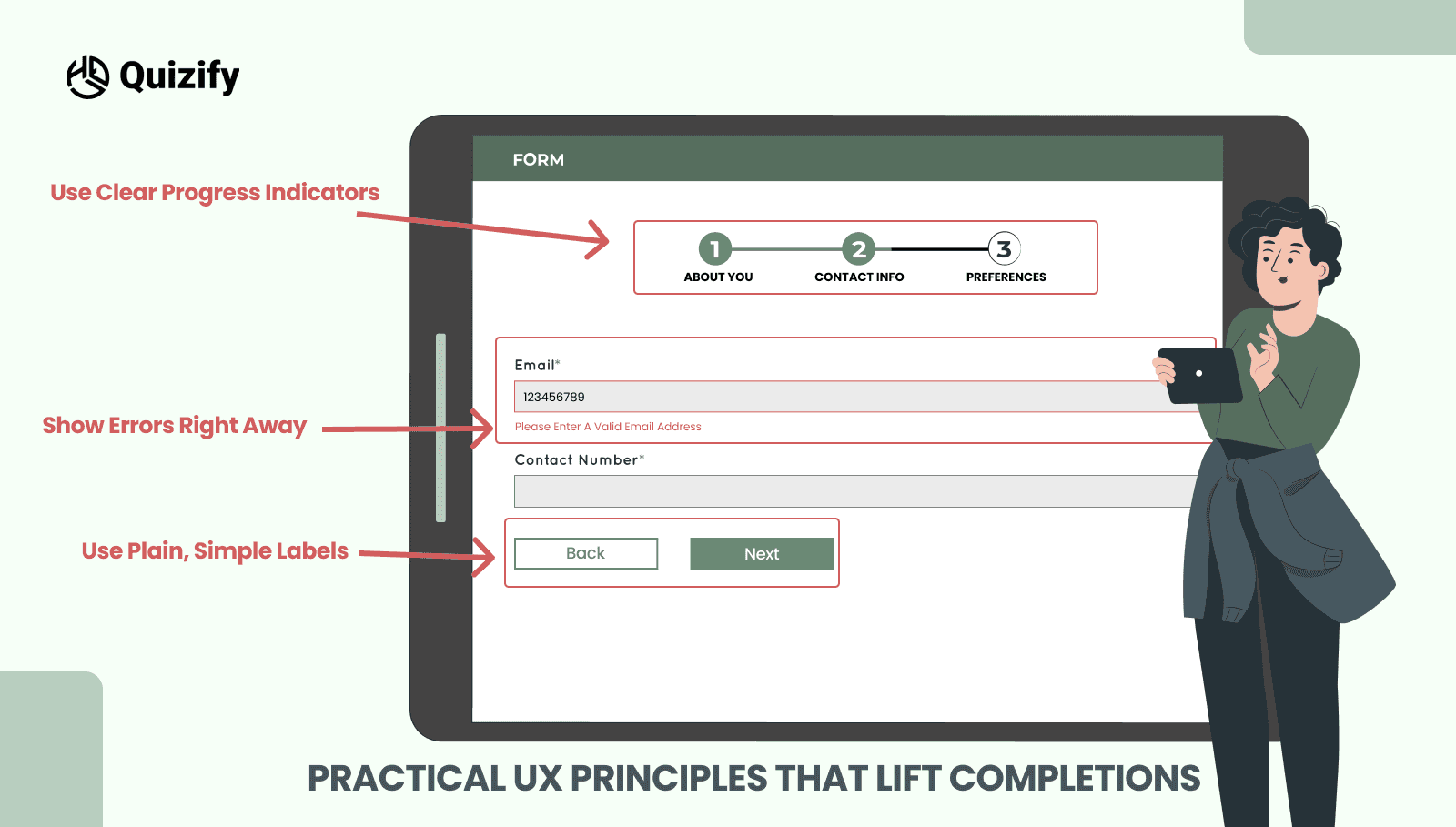
2. Use Plain, Simple Labels

Write form labels and instructions in everyday language.

Why it helps:
People understand forms faster when you avoid technical words or jargon.

Tip:
Should the use of complex terms be necessary, kindly provide explanations through small tooltips.

3. Show Errors Right Away

Tell users about mistakes as soon as they move to the next field.

Why it helps:
Users don’t get frustrated by fixing errors at the end.

Best practice:
Please display the error beside the field and provide a brief explanation on how to resolve it.

4. Use Clear Progress Indicators

If your form has multiple steps, show where users are and what’s coming next.

Why it helps:
People are more likely to finish when they know how much is left.

Better example:
"About You” instead of “Step 3.”

5. Make Forms Accessible for Everyone

Design forms that everyone can use easily.

This includes:

  • Proper labels linked to inputs

  • Keyboard navigation support

  • Clear focus indicators

Why it helps:
Accessible forms are easier for everyone—not just users with disabilities—and they convert better.

For best practices, follow trusted guidelines like W3C’s form accessibility standards.

Common Mistakes to Avoid 

  • Splitting without purpose
    Do not turn five fields into five screens. Group by meaning, not by database column.

  • Hiding decision makers
    If a field changes price, plan, or availability, do not bury it on step four. Keep deal breakers visible early.

  • Front-loading friction
    Password creation or payment details too soon can spike exits. Show value first, then ask for the high-friction fields.

  • Sticky bars that cover content
    On small screens, a fixed header or footer can hide the Next button. Test on real devices before you ship.

A Simple Test Plan to Pick the Winner
A Simple Test Plan to Pick the Winner |  Quizify

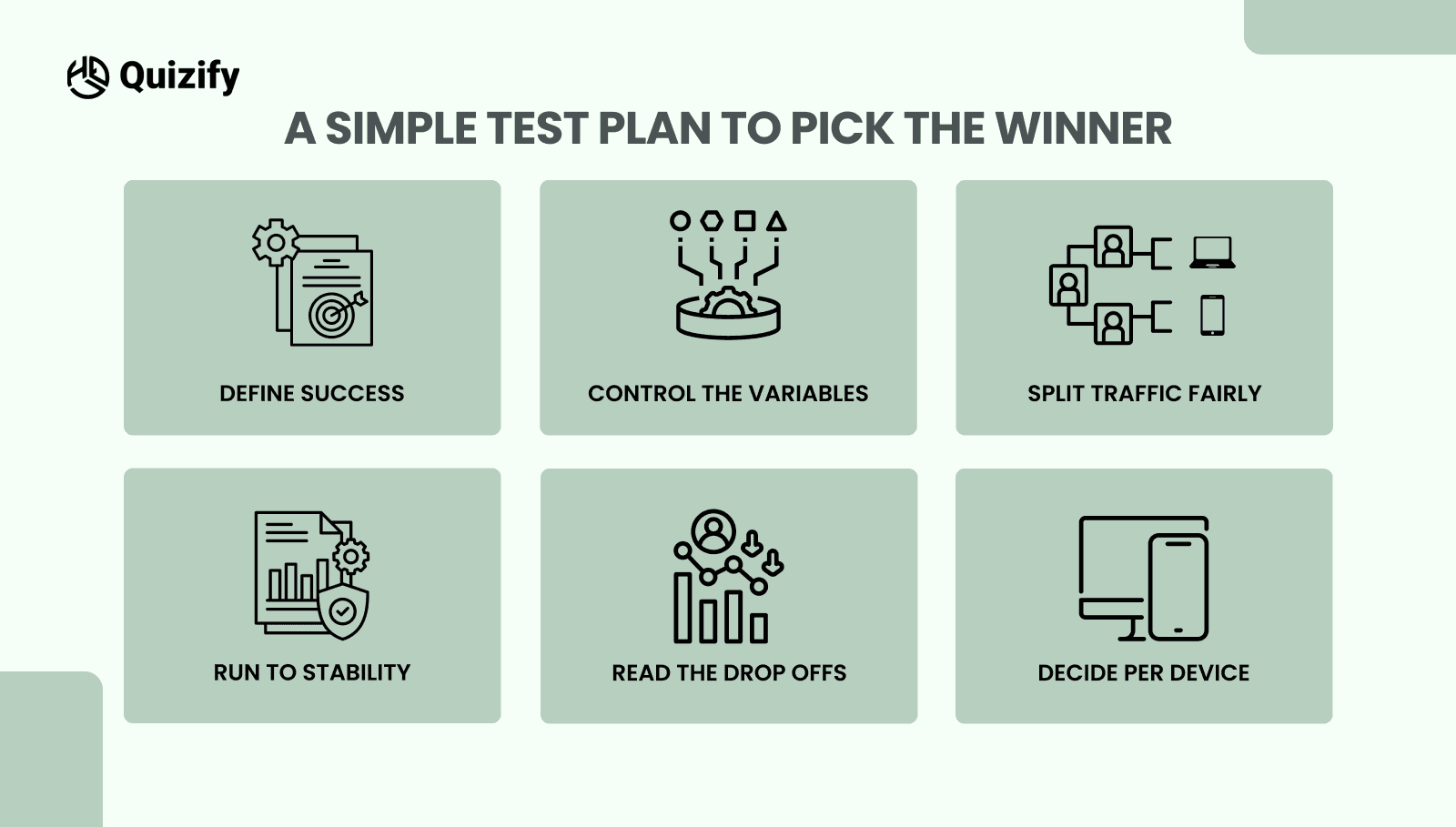
You do not need a new tool stack to test a multi-step form against a single-page form. Run this one-week plan. 

  1. Define success
    Pick primary and secondary metrics. For signups, measure start rate, completion rate, median time to complete, and error rate per field.

  2. Control the variables
    Keep labels, fields, colors, and copy identical. Only the layout changes between the multi-step form and the single-page form.

  3. Split traffic fairly
    Please direct the same audience to both versions. If possible, split by device so you can read mobile and desktop separately.

  4. Run to stability
    Aim for a few hundred starts per variant. Avoid calling a winner on the first day.

  5. Read the drop-offs
    Do not stop at totals. In a multi-step form, note the step where exits spike. In a single-page form, check scroll depth and which fields cause the most errors.

  6. Decide per device
    It is common for a multi-step form to win on mobile and a single-page form to tie or win on desktop. Keep the winner per device if your platform allows it.

Implementation Tips for Each Layout

  • If you choose a multi-step form
    Group fields by means, not by department. Use clear step titles and a visible progress bar. Put the highest friction field near the end once the value is clear. Add Back for control and save on each step. Keep questions short and avoid open text when a choice will do.

  • If you choose a single-page form
    Order fields from easiest to hardest to build momentum. Use generous spacing and clear labels so the page does not feel cramped. Keep optional fields truly optional and mark them clearly. Place privacy notes near the field they relate to, not as a block at the bottom. If the page runs long, add a second Submit near the bottom.

How to Decide in Five Minutes

Ask yourself three questions and follow the outcome.

  • How many must-have fields do we truly need?
    Seven or fewer often favors a single-page form. More than seven lean toward a multi-step format.

  • How much of our traffic is mobile
    If most visitors are on phones, a multi-step form with short steps usually reduces drop-offs.

  • Do we need branching, uploads, or payments?
    If yes, steps keep context clear and reduce errors. If not, a single-page form may be simpler and faster.

Conclusion

There is no universal winner. Choose the multi-step form when you have many required fields, conditional logic, or heavy mobile traffic. Choose the single-page form when speed and simplicity are the promise and the form is short. Then confirm with a clean A/B test and keep the winning layout per device. The right choice is the one that lowers perceived effort without hiding decisions. Keep labels plain, validate early, and show progress, and you will see more people start, more people finish, and stronger data for the rest of your funnel. If you want structure ideas for quizzes and signup flows that lead into forms, browse patterns on the Quizify blog and adapt them to your layout.


Read More: Short-Form vs. Long-Form Quiz Results


If your signup rates are dropping or conversions feel stuck, your form layout could be the hidden reason. Choosing between a multi-step form and a single-page form directly impacts user experience, perceived effort, mobile usability, and overall conversion rates. The right structure can reduce friction, improve error handling, and increase completions — especially for mobile visitors. In this guide, we’ll compare multi-step vs. single-page forms, share practical conversion optimization tips, and outline a simple A/B test plan so you can make data-driven decisions that boost results.

An Overview of Each Layout Type

  • Multi-step form
    A form split into short screens. Each step collects a small group of fields and shows progress with clear Next and Back actions.

  • Single-page form
    All required fields live on one screen. Users can scan everything at once, scroll, complete, and submit in a single move.

When a Multi-Step Form Wins

When a Multi-Step Form Wins | Quizify
  • Mobile heavy traffic
    A multi-step form reduces perceived effort by chunking questions. A clear indicator such as Step 2 of 5 keeps people moving.

  • Complex inputs or branching
    Conditional logic, file uploads, or role-based paths are easier to understand in steps. Context stays focused, and confusion drops.

  • Progress psychology
    Small wins motivate me. Short steps with visible progress reduce mid-flow abandonment.

  • Validation and recovery
    You can validate as people go, catch errors early, and save partial progress. Losing everything at submit is less likely.

  • Compliance and consent
    If legal text needs space, a multi-step form can place it where it is relevant, not as a wall at the end.

When a Single-Page Form Wins

When a Single-Page Form Wins | Quizify
  • Very few fields
    If you only need a name, email, and one qualifier, a single-page form removes extra clicks and feels fast.

  • Experienced audiences
    Technical users often prefer scanning all fields, filling quickly, and submitting without interruptions.

  • Instant promise
    For events, waitlists, or free resources, one page aligns with the promise of speed.

Practical UX Principles That Lift Completions

Practical UX Principles That Lift Completions

1. Set Clear Time Expectations

Let users know how long the form will take.

Why it helps:
When people see “Takes less than 2 minutes,” they feel more comfortable starting—especially on mobile.

Simple example:
"Quick form—takes under 2 minutes to complete.”

2. Use Plain, Simple Labels

Write form labels and instructions in everyday language.

Why it helps:
People understand forms faster when you avoid technical words or jargon.

Tip:
Should the use of complex terms be necessary, kindly provide explanations through small tooltips.

3. Show Errors Right Away

Tell users about mistakes as soon as they move to the next field.

Why it helps:
Users don’t get frustrated by fixing errors at the end.

Best practice:
Please display the error beside the field and provide a brief explanation on how to resolve it.

4. Use Clear Progress Indicators

If your form has multiple steps, show where users are and what’s coming next.

Why it helps:
People are more likely to finish when they know how much is left.

Better example:
"About You” instead of “Step 3.”

5. Make Forms Accessible for Everyone

Design forms that everyone can use easily.

This includes:

  • Proper labels linked to inputs

  • Keyboard navigation support

  • Clear focus indicators

Why it helps:
Accessible forms are easier for everyone—not just users with disabilities—and they convert better.

For best practices, follow trusted guidelines like W3C’s form accessibility standards.

Common Mistakes to Avoid 

  • Splitting without purpose
    Do not turn five fields into five screens. Group by meaning, not by database column.

  • Hiding decision makers
    If a field changes price, plan, or availability, do not bury it on step four. Keep deal breakers visible early.

  • Front-loading friction
    Password creation or payment details too soon can spike exits. Show value first, then ask for the high-friction fields.

  • Sticky bars that cover content
    On small screens, a fixed header or footer can hide the Next button. Test on real devices before you ship.

A Simple Test Plan to Pick the Winner

A Simple Test Plan to Pick the Winner |  Quizify

You do not need a new tool stack to test a multi-step form against a single-page form. Run this one-week plan. 

  1. Define success
    Pick primary and secondary metrics. For signups, measure start rate, completion rate, median time to complete, and error rate per field.

  2. Control the variables
    Keep labels, fields, colors, and copy identical. Only the layout changes between the multi-step form and the single-page form.

  3. Split traffic fairly
    Please direct the same audience to both versions. If possible, split by device so you can read mobile and desktop separately.

  4. Run to stability
    Aim for a few hundred starts per variant. Avoid calling a winner on the first day.

  5. Read the drop-offs
    Do not stop at totals. In a multi-step form, note the step where exits spike. In a single-page form, check scroll depth and which fields cause the most errors.

  6. Decide per device
    It is common for a multi-step form to win on mobile and a single-page form to tie or win on desktop. Keep the winner per device if your platform allows it.

Implementation Tips for Each Layout

  • If you choose a multi-step form
    Group fields by means, not by department. Use clear step titles and a visible progress bar. Put the highest friction field near the end once the value is clear. Add Back for control and save on each step. Keep questions short and avoid open text when a choice will do.

  • If you choose a single-page form
    Order fields from easiest to hardest to build momentum. Use generous spacing and clear labels so the page does not feel cramped. Keep optional fields truly optional and mark them clearly. Place privacy notes near the field they relate to, not as a block at the bottom. If the page runs long, add a second Submit near the bottom.

How to Decide in Five Minutes

Ask yourself three questions and follow the outcome.

  • How many must-have fields do we truly need?
    Seven or fewer often favors a single-page form. More than seven lean toward a multi-step format.

  • How much of our traffic is mobile
    If most visitors are on phones, a multi-step form with short steps usually reduces drop-offs.

  • Do we need branching, uploads, or payments?
    If yes, steps keep context clear and reduce errors. If not, a single-page form may be simpler and faster.

Conclusion

There is no universal winner. Choose the multi-step form when you have many required fields, conditional logic, or heavy mobile traffic. Choose the single-page form when speed and simplicity are the promise and the form is short. Then confirm with a clean A/B test and keep the winning layout per device. The right choice is the one that lowers perceived effort without hiding decisions. Keep labels plain, validate early, and show progress, and you will see more people start, more people finish, and stronger data for the rest of your funnel. If you want structure ideas for quizzes and signup flows that lead into forms, browse patterns on the Quizify blog and adapt them to your layout.


Read More: Short-Form vs. Long-Form Quiz Results


If your signup rates are dropping or conversions feel stuck, your form layout could be the hidden reason. Choosing between a multi-step form and a single-page form directly impacts user experience, perceived effort, mobile usability, and overall conversion rates. The right structure can reduce friction, improve error handling, and increase completions — especially for mobile visitors. In this guide, we’ll compare multi-step vs. single-page forms, share practical conversion optimization tips, and outline a simple A/B test plan so you can make data-driven decisions that boost results.

An Overview of Each Layout Type

  • Multi-step form
    A form split into short screens. Each step collects a small group of fields and shows progress with clear Next and Back actions.

  • Single-page form
    All required fields live on one screen. Users can scan everything at once, scroll, complete, and submit in a single move.

When a Multi-Step Form Wins

When a Multi-Step Form Wins | Quizify
  • Mobile heavy traffic
    A multi-step form reduces perceived effort by chunking questions. A clear indicator such as Step 2 of 5 keeps people moving.

  • Complex inputs or branching
    Conditional logic, file uploads, or role-based paths are easier to understand in steps. Context stays focused, and confusion drops.

  • Progress psychology
    Small wins motivate me. Short steps with visible progress reduce mid-flow abandonment.

  • Validation and recovery
    You can validate as people go, catch errors early, and save partial progress. Losing everything at submit is less likely.

  • Compliance and consent
    If legal text needs space, a multi-step form can place it where it is relevant, not as a wall at the end.

When a Single-Page Form Wins

When a Single-Page Form Wins | Quizify
  • Very few fields
    If you only need a name, email, and one qualifier, a single-page form removes extra clicks and feels fast.

  • Experienced audiences
    Technical users often prefer scanning all fields, filling quickly, and submitting without interruptions.

  • Instant promise
    For events, waitlists, or free resources, one page aligns with the promise of speed.

Practical UX Principles That Lift Completions

Practical UX Principles That Lift Completions

1. Set Clear Time Expectations

Let users know how long the form will take.

Why it helps:
When people see “Takes less than 2 minutes,” they feel more comfortable starting—especially on mobile.

Simple example:
"Quick form—takes under 2 minutes to complete.”

2. Use Plain, Simple Labels

Write form labels and instructions in everyday language.

Why it helps:
People understand forms faster when you avoid technical words or jargon.

Tip:
Should the use of complex terms be necessary, kindly provide explanations through small tooltips.

3. Show Errors Right Away

Tell users about mistakes as soon as they move to the next field.

Why it helps:
Users don’t get frustrated by fixing errors at the end.

Best practice:
Please display the error beside the field and provide a brief explanation on how to resolve it.

4. Use Clear Progress Indicators

If your form has multiple steps, show where users are and what’s coming next.

Why it helps:
People are more likely to finish when they know how much is left.

Better example:
"About You” instead of “Step 3.”

5. Make Forms Accessible for Everyone

Design forms that everyone can use easily.

This includes:

  • Proper labels linked to inputs

  • Keyboard navigation support

  • Clear focus indicators

Why it helps:
Accessible forms are easier for everyone—not just users with disabilities—and they convert better.

For best practices, follow trusted guidelines like W3C’s form accessibility standards.

Common Mistakes to Avoid 

  • Splitting without purpose
    Do not turn five fields into five screens. Group by meaning, not by database column.

  • Hiding decision makers
    If a field changes price, plan, or availability, do not bury it on step four. Keep deal breakers visible early.

  • Front-loading friction
    Password creation or payment details too soon can spike exits. Show value first, then ask for the high-friction fields.

  • Sticky bars that cover content
    On small screens, a fixed header or footer can hide the Next button. Test on real devices before you ship.

A Simple Test Plan to Pick the Winner

A Simple Test Plan to Pick the Winner |  Quizify

You do not need a new tool stack to test a multi-step form against a single-page form. Run this one-week plan. 

  1. Define success
    Pick primary and secondary metrics. For signups, measure start rate, completion rate, median time to complete, and error rate per field.

  2. Control the variables
    Keep labels, fields, colors, and copy identical. Only the layout changes between the multi-step form and the single-page form.

  3. Split traffic fairly
    Please direct the same audience to both versions. If possible, split by device so you can read mobile and desktop separately.

  4. Run to stability
    Aim for a few hundred starts per variant. Avoid calling a winner on the first day.

  5. Read the drop-offs
    Do not stop at totals. In a multi-step form, note the step where exits spike. In a single-page form, check scroll depth and which fields cause the most errors.

  6. Decide per device
    It is common for a multi-step form to win on mobile and a single-page form to tie or win on desktop. Keep the winner per device if your platform allows it.

Implementation Tips for Each Layout

  • If you choose a multi-step form
    Group fields by means, not by department. Use clear step titles and a visible progress bar. Put the highest friction field near the end once the value is clear. Add Back for control and save on each step. Keep questions short and avoid open text when a choice will do.

  • If you choose a single-page form
    Order fields from easiest to hardest to build momentum. Use generous spacing and clear labels so the page does not feel cramped. Keep optional fields truly optional and mark them clearly. Place privacy notes near the field they relate to, not as a block at the bottom. If the page runs long, add a second Submit near the bottom.

How to Decide in Five Minutes

Ask yourself three questions and follow the outcome.

  • How many must-have fields do we truly need?
    Seven or fewer often favors a single-page form. More than seven lean toward a multi-step format.

  • How much of our traffic is mobile
    If most visitors are on phones, a multi-step form with short steps usually reduces drop-offs.

  • Do we need branching, uploads, or payments?
    If yes, steps keep context clear and reduce errors. If not, a single-page form may be simpler and faster.

Conclusion

There is no universal winner. Choose the multi-step form when you have many required fields, conditional logic, or heavy mobile traffic. Choose the single-page form when speed and simplicity are the promise and the form is short. Then confirm with a clean A/B test and keep the winning layout per device. The right choice is the one that lowers perceived effort without hiding decisions. Keep labels plain, validate early, and show progress, and you will see more people start, more people finish, and stronger data for the rest of your funnel. If you want structure ideas for quizzes and signup flows that lead into forms, browse patterns on the Quizify blog and adapt them to your layout.


Read More: Short-Form vs. Long-Form Quiz Results


Join our newsletter list

Sign up to get the most recent blog articles in your email every week.